Zār
Recorded from the 19th century; origins debated
Ethiopia, Sudan and Egypt
Zār is a spirit-possession and healing tradition led mostly by women, found in Ethiopia, Sudan, Egypt and around the Red Sea. Its origins are debated: the word appears for a possessing spirit in a 16th-century Ge'ez manuscript from Ethiopia, while the first clear records of zār ceremonies date from the 1800s. Many scholars think it spread north along with the 19th-century trade in enslaved Ethiopian people. In Sudan, zār tumbura is practised mainly by descendants of enslaved people from the south and west.
What zār is
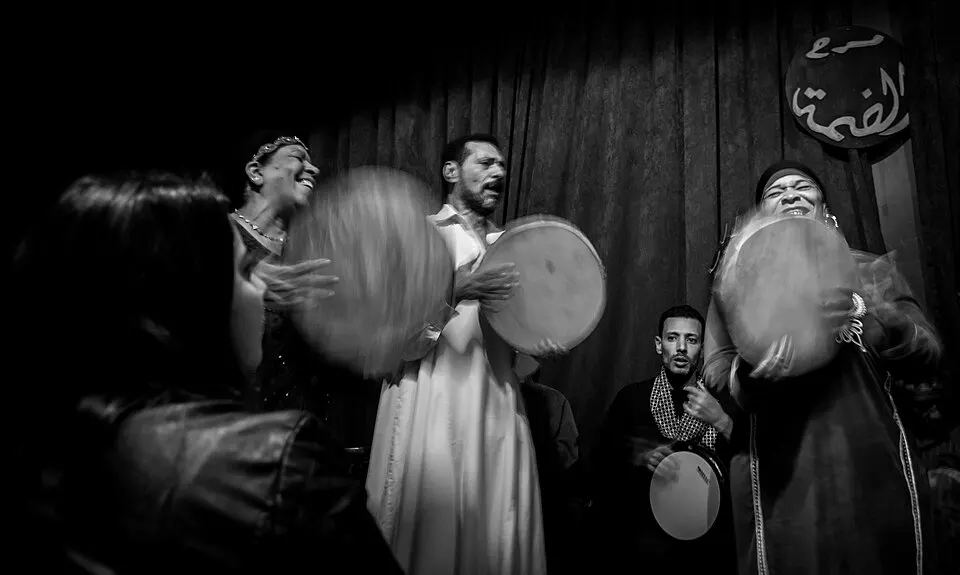
Zār is a tradition of spirit possession and healing found in Ethiopia, Sudan, Egypt and other lands around the Red Sea and the Horn of Africa. The word names both the spirits and the ceremonies held for them. In zār belief, a spirit may settle on a person and cause illness or distress. Possession is often seen as lifelong, so many scholars describe the ceremony as a way of coming to terms with the spirit rather than driving it out; some Egyptian accounts, though, describe zār as an exorcism, and both descriptions are in use. Ceremonies are built on music, drumming, songs for particular spirits, and dance, and they are led by an experienced leader, often a woman, who knows the spirits and their songs.
A tradition of women
Zār is best known as a women's tradition. Field studies in Egypt and Sudan have found that many of those taking part are women, and scholars such as the anthropologist Janice Boddy, who studied zār in a village in northern Sudan, have written about how the ceremonies give women a space of their own. Commentators note that in societies where women had little public power, zār was one of the few gatherings in which women took the centre of the stage. Men take part in some forms: Sudanese tumbura, for example, is performed by both men and women.
Origins: a debated question
Where zār began is not settled. Most scholars place its roots in Ethiopia. The word appears for a possessing spirit in a 16th-century Ge'ez manuscript, but it is not known whether zār ceremonies were held at that time or what form they took. The earliest clear written account of zār ceremonies comes from highland Ethiopia in 1839, recorded by missionaries.
Many scholars think zār reached Egypt and Sudan in the 19th century with the trade in enslaved people from Ethiopia, especially Oromo women. Others give different routes: one account in the scholarship suggests that zār spread through the Baggara of Sudan. Hager El Hadidi's study of zār in Egypt and the 1991 collection on the "zar-bori cult" edited by I. M. Lewis and colleagues set out these different views.
Forms in Sudan and Egypt
In Sudan, practitioners distinguish two main forms. Zār bori is the more widespread, practised mostly by freeborn women in northern Sudan. Zār tumbura is less common and is tied especially to communities descended from enslaved people from the south and west of the country.
In Egypt, zār absorbed elements of popular Islam, including Sufi practice and devotion to saints, both Muslim and Christian. Scholars note that Islam, and especially Sufism, shaped both zār ritual and how its groups are organised. Ceremonies may open with verses from the Qur'an and prayers before the music grows stronger.
Zār today
In Egypt, religious conservatives have criticised zār as un-Islamic, and few people now ask for ceremonies. A traditional ceremony could last several days. In Cairo, the Mazaher ensemble performs zār music at the Makan cultural centre as a public, staged show, not a healing rite, and says it is the last group performing zār in public in Egypt. Researchers report that zār ceremonies are still held in parts of Upper Egypt, including Luxor and Aswan. The music and songs of zār are now also studied and recorded as part of the musical heritage of north-east Africa.
Achievements
- 16th century: Earliest known use of the word zār for a possessing spirit, in an Ethiopian Ge'ez manuscript
- 1800s: First clear written records of zār ceremonies
- Sudan has two main forms: zār bori and zār tumbura
- Egyptian zār draws on hundreds of songs and absorbed Sufi and saint devotion
Related entries
Sources
- Hager El Hadidi, Zar: Spirit Possession, Music, and Healing Rituals in Egypt (American University in Cairo Press) (Scholarly)
- National Museum of Ethnology (Minpaku), Osaka, institutional repository: study of the zār cult (Scholarly)
- Janice Boddy, Wombs and Alien Spirits: Women, Men, and the Zār Cult in Northern Sudan (University of Wisconsin Press, 1989) (Scholarly)
- I. M. Lewis, Ahmed Al-Safi and Sayyid Hurreiz (eds.), Women's Medicine: The Zar-Bori Cult in Africa and Beyond (Edinburgh University Press, 1991) (Scholarly)
- Al-Monitor, "Egypt's ancient zar ritual puts exorcism on stage" (May 2022) (Reference)
Share and cite
Cite this page
“Zār.” Kemet to Now, https://kemettonow.com/entry/zar.
Spotted an error or have a better source? Suggest a correction.