Gnawa
At least 16th century to present
Morocco
The Gnawa of Morocco are brotherhoods whose music, songs and rituals, UNESCO says, embody a culture linked to the history of slavery and the slave trade in North Africa, with roots going back to at least the 16th century. Their all-night ceremonies join African ancestral practice, Sufi devotion and healing. UNESCO added Gnawa to its list of the intangible cultural heritage of humanity in 2019.
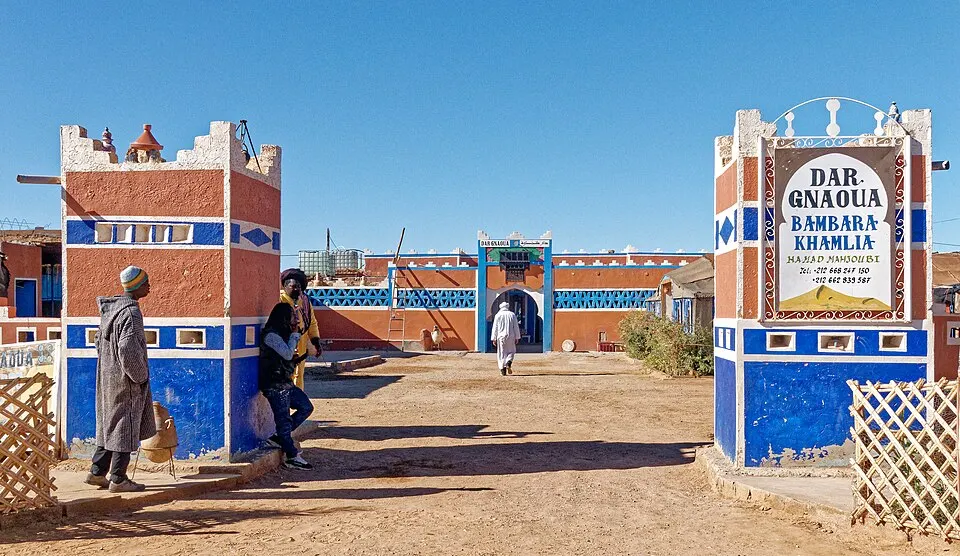
Who the Gnawa are
The Gnawa are a set of religious brotherhoods in Morocco, with their own music, songs and ceremonies. They trace their roots to sub-Saharan West Africans brought to Morocco through the trans-Saharan slave trade. UNESCO, in its 2019 decision, describes Gnawa songs, rhythms and practices as embodying a culture linked to the history of slavery and the slave trade in North Africa. Morocco's nomination file dates the veneration of Muslim holy men in Gnawa practice to at least the sixteenth century.
Gnawa culture is Muslim. It joins African ancestral practices with Arab-Muslim and Sufi traditions. Scholars and Gnawa themselves describe it as a meeting point between sub-Saharan Africa and the Maghreb.
The ceremony
At the centre of Gnawa life is an all-night ceremony, usually called the lila ("night"). Morocco's nomination to UNESCO describes it as a therapeutic ritual of possession, carried out through rhythm and trance, that combines ancestral African practice with Arab-Muslim influence. The night moves through a fixed sequence of songs and rhythms, each tied to particular spirits, with incense and colours that belong to each one.
The ceremony is led by a maalem, a master musician. He plays the guembri, a three-stringed bass lute carved from wood and covered with skin, while others sing in call and response and keep time with large iron castanets called qraqeb. Participants who are moved by the music may enter trance. For the Gnawa this is a form of healing and of making peace with the spirits, held within a Muslim framework.
This entry describes the ceremony historically. Its knowledge is passed on within the brotherhoods, and nothing here is meant as instructions.
Passing it on
UNESCO notes that the knowledge and skills of Gnawa culture are passed down informally, within families and close social circles.
For a long time the brotherhoods were little known outside their own communities and were often looked down on, according to reporting at the time of the UNESCO listing.
From the margins to world stages
That changed in the late 1990s, when a Gnawa festival began in Essaouira, a port city on Morocco's Atlantic coast. The festival brought Gnawa musicians together with musicians from around the world and drew large crowds, and it made Gnawa music widely known. Sources date the first festival to 1997 or 1998.
On 12 December 2019, at its fourteenth session in Bogotá, UNESCO's intergovernmental committee inscribed Gnawa on the Representative List of the Intangible Cultural Heritage of Humanity. Gnawa musicians celebrated the decision with music in the streets.
Gnawa in Africa's history
The Gnawa story is part of a history that is often left out: the movement of enslaved Africans northward across the Sahara, alongside the better-known Atlantic trade. Their tradition shows how people taken far from home rebuilt a spiritual life in a new home, and kept something of their origins in music. Many came from West Africa and the Sahel, lands once ruled by empires such as the Mali Empire and the Songhai Empire. Communities in Europe, such as Barcelona, now host Gnawa groups as well.
Achievements
- At least the 16th century: Origins tied to the history of slavery in North Africa, according to UNESCO
- Late 1990s: The Essaouira festival brought Gnawa music to a wide public
- 12 December 2019: Inscribed on UNESCO's Representative List of the Intangible Cultural Heritage of Humanity
Related entries
Sources
- UNESCO Intangible Cultural Heritage, "Gnawa" (inscribed 2019) (Primary source)
- BlackPast, "The Gnawa (Islamic Sect) (11th c.- )" (Reference)
- Barcelona City Council, Office of Religious Affairs, "The sound spirituality of the Gnawa community" (Reference)
- UNESCO Intergovernmental Committee, Decision 14.COM 10.B.26 (Gnawa, 2019) (Primary source)
- Arab News (AFP), "Morocco's Gnawa musical culture listed by UNESCO" (2019) (Reference)
Share and cite
Cite this page
“Gnawa.” Kemet to Now, https://kemettonow.com/entry/gnawa.
Suggest a correction: opens once the database is connected.