Mami Wata
Centuries old; best documented from the late 19th century
West and Central Africa and the African diaspora
Mami Wata ("Mother Water") is a water spirit honoured by many peoples across West and Central Africa and the African Atlantic world. She is often shown as a mermaid, a snake charmer or both. Art historian Henry John Drewal traced her snake charmer image to a late-19th-century German print, and his exhibition on her art toured the United States from 2008, including the Smithsonian in 2009.
Who Mami Wata is
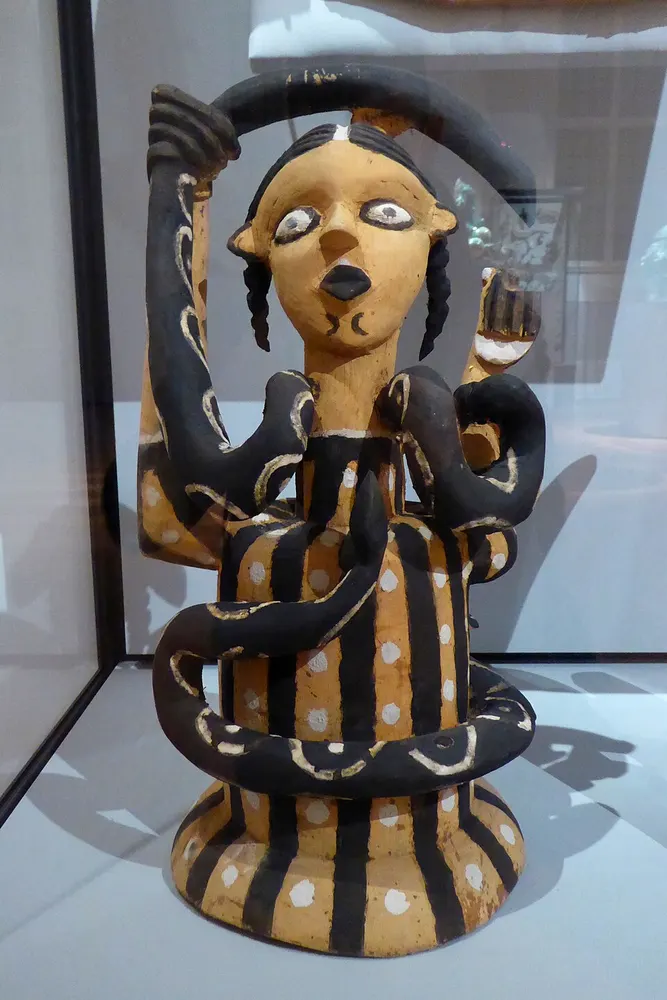
Mami Wata is a water spirit honoured across much of Africa and the African Atlantic world. Her name is pidgin English for "Mother Water." She is linked to the sea, rivers and other waters. Devotees seek her for wealth and beauty, for healing, and, among many women, for children; her gifts are said to come with conditions that must be kept. The Smithsonian's National Museum of African Art describes her as beautiful and seductive, protective and also dangerous. People in many lands, speaking many languages, honour her, and Drewal writes not only of Mami Wata but of many mami watas and related water spirits.
How she is shown
In art, Mami Wata is often a mermaid, with the body of a woman and the tail of a fish, or a snake charmer with a large snake around her shoulders, or a mix of the two. Snakes are ancient symbols of water spirits in Africa and often appear with her. She is often pictured with valuables such as golden combs and mirrors, signs of her wealth. Museums note that her images show how creatively Africans took up imported ideas and pictures.
The German print
Art historian Henry John Drewal of the University of Wisconsin–Madison spent many years studying her art. He traced one of her most influential images to a print of a female snake charmer made in Germany in the late 19th century, probably showing a performer from South or Southeast Asia. Copies of the print circulated widely in West Africa, and a reprint made in Bombay in 1955 spread it further. Africans took this foreign picture and gave it new meaning as an image of a powerful water spirit they already honoured. The same picture travelled to the Americas: in the Dominican Republic, Drewal and others have shown, it became an image of Santa Marta la Dominadora.
Drewal's work is a reminder that the belief in water spirits in Africa is much older than the print. The print gave many artists a new way to picture her.
The exhibition
Drewal guest-curated the exhibition "Mami Wata: Arts for Water Spirits in Africa and Its Diasporas," organised by the Fowler Museum at UCLA. It opened there in 2008, moved to the Chazen Museum of Art in Wisconsin, and was shown at the Smithsonian's National Museum of African Art in Washington from April to July 2009, before travelling to other museums. It brought together traditional and contemporary art from West and Central Africa, the Caribbean, Brazil and the United States, covering about 500 years of art and history related to her.
Across the Atlantic
Enslaved Africans carried their water spirits with them across the Atlantic. The exhibition showed related images and practices in the Caribbean, Brazil and the United States, as well as across West and Central Africa.
Why she matters
Mami Wata shows how African spiritual traditions take in new things while keeping old ones. Ancient beliefs about water spirits met trade goods and printed pictures from far away, and artists made something new from them. Museums now treat her images as an important part of African and diaspora art.
Achievements
- Recognized across Africa and the African Atlantic world as a powerful water spirit
- Her common image of a woman holding snakes traces to a late-19th-century German snake charmer print
- 2008: "Mami Wata: Arts for Water Spirits in Africa and Its Diasporas" opened at the Fowler Museum, UCLA, curated by Henry John Drewal
Related entries
Sources
- Smithsonian National Museum of African Art, "Mami Wata figure" (2009-16-1) (Primary source)
- Henry John Drewal, "Mami Wata: Arts for Water Spirits in Africa and Its Diasporas," African Arts 41, no. 2 (2008) (Scholarly)
- University of Wisconsin–Madison, Department of African American Studies, "Henry J. Drewal" (Reference)
- Smithsonian Institution newsdesk, "Water Spirit is Focus of National Museum of African Art Exhibition" (2009) (Reference)
- Smithsonian Magazine, "The Many Faces of Mami Wata" (Reference)
Share and cite
Cite this page
“Mami Wata.” Kemet to Now, https://kemettonow.com/entry/mami-wata.
Spotted an error or have a better source? Suggest a correction.