Haitian Vodou
18th century (colonial Saint-Domingue) – present
Haiti and its diaspora
Haitian religion that took shape among enslaved Africans in Saint-Domingue, serving spirits called lwa through song, drumming and possession; it draws on Fon, Kongo and Yoruba traditions and links many lwa with Catholic saints.
Origins
Haitian Vodou took shape in the 18th century in the French colony of Saint-Domingue. Its roots are in the Atlantic slave trade, which brought hundreds of thousands of West and Central Africans to labour on the colony's sugar plantations. The name comes from Fon and Ewe words for "spirit" or "god." The Pluralism Project at Harvard describes Vodou as a blend of Fon, Kongo and Yoruba religion with French Catholicism. After independence in 1804, the arrival of captives stopped, and Haitians went on developing the tradition themselves. Practitioners often describe their religion simply as "serving the spirits."
Beliefs and practice
Vodou recognizes a supreme God, Bondye ("Good God"), who is seen as distant from daily affairs. Bondye's energy reaches people through the lwa, spirits who take an active part in human life. The lwa are grouped into "nations" tied to African places and peoples. The two best known are the Rada rites, named after the Fon-speaking city of Allada and linked with West Africa, and the Petwo rites, more closely tied to the experience of slavery and rebellion in Haiti.
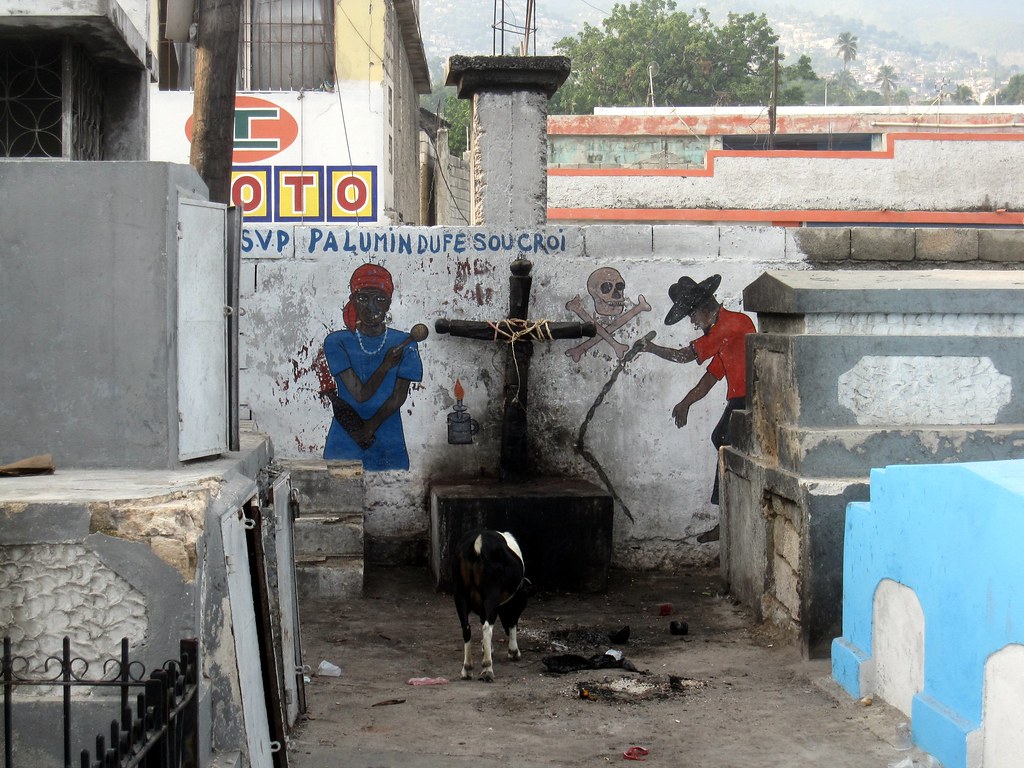
Ceremonies are led by priests (oungan) and priestesses (manbo), who also teach initiates and offer healing and counsel. Temples have a sacred centre pole. Participants trace vèvè, intricate cornmeal designs, on the ground to call particular lwa. With singing, drumming and dance, a lwa may "mount" a devotee and speak through them. Sacred arts include sequined flags, decorated bottles, and the beaded gourd rattle (ason) that marks a priest's authority. There is no single scripture or central authority, and practice varies between communities.
Most practitioners are also Roman Catholic. Many lwa are served through Catholic saints. Danbala is linked with St. Patrick, Ogou with St. James, and Ezili Danto with Our Lady of Mount Carmel. The ritual calendar follows saints' feast days. Scholars such as Karen McCarthy Brown see this pairing both as a form of protection under slavery and as a continuation of African religious borrowing.
Revolution, repression and recognition
Tradition holds that a Vodou ceremony at Bwa Kayiman (Bois Caïman) in August 1791, led by Boukman Dutty and a priestess, helped launch the Haitian Revolution. Historians debate how accurate the surviving accounts are, but the event holds a central place in Haitian national identity.
Vodou faced long repression. The colonial Code Noir of 1685 banned African religions, and after independence many practices stayed officially prohibited for well over a century. Catholic-led "antisuperstition" campaigns, including one in 1941–1942, destroyed temples and sacred objects and jailed priests. Some of these drives had foreign backing, including during the U.S. occupation of 1915–1934. In 2003, under President Jean-Bertrand Aristide, the state officially recognized Vodou as a religion.
Diaspora and misrepresentation
Since the late 1950s, Haitian migration has taken Vodou to New York, Florida, Massachusetts, New Jersey and beyond. Films and fiction spread a distorted picture of "voodoo" as dark magic. Scholars of the religion stress instead its focus on healing, community and relationship with the spirits.
Achievements
- 18th century: takes shape among enslaved West and Central Africans on Saint-Domingue's plantations
- August 1791: the Bwa Kayiman (Bois Caïman) ceremony is traditionally linked to the start of the Haitian Revolution
- Survived bans and Catholic-led "antisuperstition" campaigns, including 1941–1942
- 2003: officially recognized as a religion by the Haitian state
Related entries
Sources
- Sacred Arts of the Black Atlantic, Duke University, "Haitian Vodou" (Scholarly)
- The Pluralism Project, Harvard University, "Vodou, Serving the Spirits" (Scholarly)
- Michael Mazzei, EBSCO Research Starters, "Haitian Vodou" (Reference)
- Florida State College at Jacksonville, World Religions (open textbook), "What is Vodou?" (Scholarly)
Suggest a correction: opens once the database is connected.