Kenneth Kaunda
1924 – 2021
Zambia
Kenneth Kaunda led Northern Rhodesia to independence as Zambia and served as its first president from 1964 to 1991. He backed liberation movements across southern Africa, but in 1973 made his United National Independence Party the only legal party; he left office after losing the 1991 multi-party election to Frederick Chiluba.
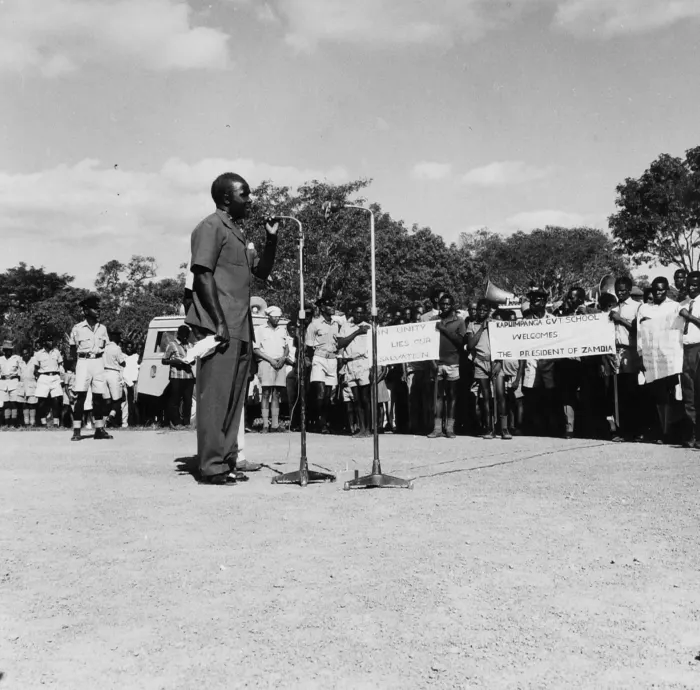
A mission childhood
Kenneth David Kaunda was born on April 28, 1924, at Lubwa Mission near Chinsali, in what was then the British colony of Northern Rhodesia. He was the youngest of eight children. His father was a minister and teacher who had come from Malawi (then Nyasaland) in 1904, and his mother is described as the first African woman to teach in colonial Zambia. He was educated in the mission schools where his parents taught, run under the Church of Scotland.
Kaunda followed his parents into teaching. Sources say he was headmaster at Lubwa from 1943 to 1945, and that in 1948 he went to Mufulira, a copper-mining town, where accounts describe him as teaching and also setting up a farmers' cooperative.
Into nationalist politics
Kaunda entered politics through the Northern Rhodesia African National Congress, led by Harry Nkumbula, which opposed the colonial Central African Federation. In 1958, after a clash over strategy, Kaunda broke away and founded the Zambia African National Congress (ZANC). The colonial authorities imprisoned him for his political activities.
Kaunda was released in January 1960 and was soon elected president of the United National Independence Party (UNIP), the successor to ZANC.
First president of Zambia
In 1964 Northern Rhodesia became the independent Republic of Zambia, and Kaunda became its first president. He would hold the office for twenty-seven years.
Kaunda set out a guiding philosophy he called Zambian Humanism. It blended traditional African values with Christian and socialist ideas, and it was opposed to capitalism as an economic system. In April 1967 it was officially adopted as the national philosophy.
Supporting liberation in southern Africa
Kaunda confronted the white-minority governments of neighbouring Rhodesia (now Zimbabwe) and South Africa, and he backed liberation movements across southern Africa. This stand carried heavy economic costs for Zambia.
One-party rule and its end
At home Kaunda faced rivalry between regions and parties. Saying he wanted to end violence between parties, he moved to one-party rule in 1972; the following year a new constitution made UNIP the only legal party.
In 1991 Zambia held multi-party elections, and Kaunda lost the presidency to Frederick Chiluba. He then left office.
Later life
After leaving office, Kaunda clashed often with Chiluba's government. After his son Wezi was murdered in 1999, he stepped back from front-line politics and devoted himself to the fight against HIV and AIDS, working through his children of Africa foundation.
Kenneth Kaunda died in Lusaka on June 17, 2021, at the age of 97. He is remembered as the founding father of independent Zambia.
Achievements
- 1924: Born at Lubwa Mission near Chinsali, Northern Rhodesia, to parents who were both teachers
- 1958: Broke away to form the Zambia African National Congress
- 1960: Led the United National Independence Party (UNIP) after his release from prison
- 1964: Became the first president of independent Zambia
- 1967: Zambian Humanism adopted as the national philosophy
- 1973: One-party rule under UNIP written into the constitution
- 1991: Left office after losing the multi-party election to Frederick Chiluba
Related entries
Sources
- South African History Online, "Kenneth David Kaunda" (Reference)
- Encyclopedia.com, "Kenneth David Kaunda" (Reference)
- Chatham House, "Kenneth Kaunda: The man behind the statesman" (2021) (Reference)
- EBSCO Research Starters, "Kaunda Becomes Zambia's First President" (Reference)
- Kenneth Kaunda Foundation, "Biography" (Reference)
Share and cite
Cite this page
“Kenneth Kaunda.” Kemet to Now, https://kemettonow.com/entry/kenneth-kaunda.
Suggest a correction: opens once the database is connected.