Kwame Nkrumah
1909 – 1972
Ghana (Gold Coast)
Pan-Africanist leader who guided the Gold Coast to independence as Ghana on 6 March 1957, served as prime minister and then president until a 1966 coup, and helped found the Organization of African Unity.
Early life and education
Kwame Nkrumah was born in Nkroful, in the southwest of the Gold Coast colony. His birth date is uncertain: according to the New York Public Library, the official date recorded by a Catholic priest was 21 September 1902, but Nkrumah later calculated 18 September 1909 as more likely, and 1909 is the year most sources give. He trained as a teacher at the Government Training College at Achimota, graduating in 1930.
In 1935 he went to the United States, earning a BA from Lincoln University in Pennsylvania in 1939 and a master's degree from the University of Pennsylvania, where he began but did not finish a doctorate. In 1945 he moved to London to study, and there he became active in anti-colonial and Pan-African organizing, including the West African Students' Union.
Road to independence
Nkrumah returned home in 1947 as general secretary of the United Gold Coast Convention (UGCC). After riots in 1948 he was arrested with other UGCC leaders. In 1949 he broke away to found the more radical Convention People's Party (CPP) and launched a campaign of nonviolent "positive action," for which the British imprisoned him. When the CPP won the colony's first general election in February 1951, he was released and became leader of government business, then prime minister in 1952.
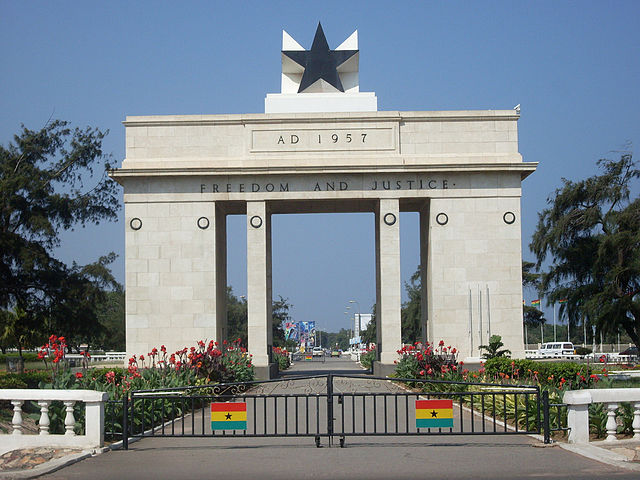
On 6 March 1957 the Gold Coast, joined with British Togoland, became independent as Ghana, with Nkrumah as prime minister. It was among the first sub-Saharan African colonies to win independence.
President of Ghana
When Ghana became a republic in 1960, Nkrumah became its first president. He nationalized the cocoa trade, the main export, in 1961, accepted aid from both the United States and the Soviet Union while keeping a neutral foreign policy, and campaigned for a united Africa. In 1963 he helped found the Organization of African Unity.
His rule also grew increasingly authoritarian. Sources describe the detention without trial of people deemed security risks, the suppression of dissidents, and his move to make the CPP the only legal party, steps that led opponents to call him a dictator.
Overthrow and exile
On 24 February 1966, while Nkrumah was abroad on an Asian tour bound for Beijing, army and police officers seized power. A CIA summary from the time, later published by the State Department, describes about a year of plotting by Ghanaian officers. Nkrumah lived the rest of his life in exile in Guinea as a guest of President Sékou Touré, continuing to write. He died of cancer in Bucharest, Romania, on 27 April 1972, and was eventually reburied in Accra in 1992.
Legacy
Nkrumah is remembered as one of the foremost advocates of Pan-Africanism and of a "United States of Africa," and as the leader who made Ghana a symbol of African independence. His record at home remains debated: admirers stress his vision and nation-building, while critics point to repression and one-party rule.
Achievements
- Founded the Convention People's Party (CPP), 1949
- Became leader of government business (1951) and prime minister (1952) of the Gold Coast
- Led Ghana to independence, 6 March 1957
- Became Ghana's first president when it became a republic, 1960
- Helped establish the Organization of African Unity, 1963
Related entries
Sources
- New York Public Library, "Kwame Nkrumah Resource Guide: Biography" (Primary source)
- BlackPast.org, "Kwame Nkrumah (1909-1972)" (Reference)
- Encyclopaedia Britannica, "Kwame Nkrumah" (Reference)
- U.S. Department of State, Office of the Historian, "Ghana" (countries page) (Primary source)
- U.S. Department of State, Office of the Historian, Foreign Relations of the United States, 1964–1968, Vol. XXIV, Document 257 (CIA memorandum on Ghana, February 1966) (Primary source)
Suggest a correction: opens once the database is connected.