John Chilembwe
c. 1871 – 1915
Chiradzulu, Nyasaland (Malawi)
John Chilembwe was a Baptist minister from Nyasaland (now Malawi) who studied in the United States and in 1900 founded the Providence Industrial Mission near Blantyre. In January 1915 he led a rising against British colonial rule and settler abuses, and he was killed by colonial forces on 3 February 1915. He is remembered in Malawi as an early hero of its independence.
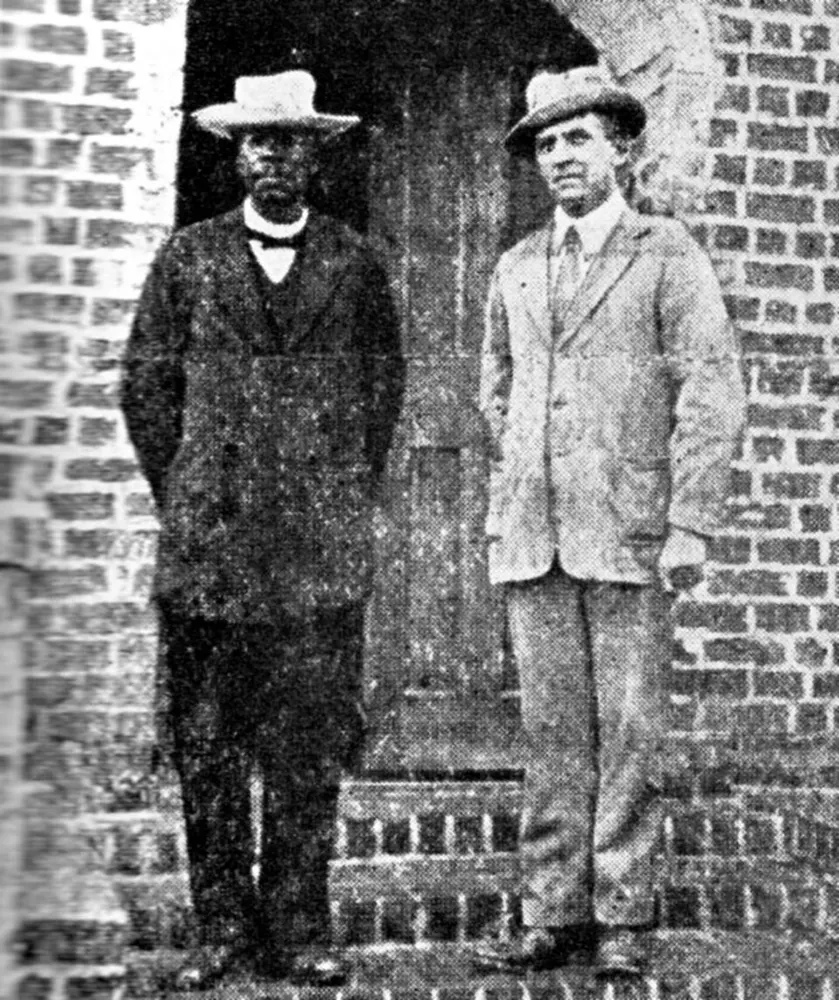
Early life and Joseph Booth
John Chilembwe was born around 1871 in what became the British colony of Nyasaland, now Malawi. In 1892 he joined the household of Joseph Booth, a British Baptist missionary who had arrived that year to set up the Zambezi Industrial Mission near Blantyre. Harvard Magazine describes Booth as an eccentric British missionary of Baptist persuasion with apocalyptic views.
Study in America
In 1897 Booth took Chilembwe to the United States. Chilembwe stayed on in Virginia, where he studied to become a Baptist pastor, and he was ordained as a minister.
The Providence Industrial Mission
Chilembwe returned to Nyasaland around 1900 (some sources say 1901) and founded the Providence Industrial Mission at Mbombwe near Chiradzulu. Chilembwe became a leader of a group of mission-educated Africans, sometimes called "new men", who wanted respect and a fair place in colonial society.
The grievances
The mission stood in an area dominated by the Magomero estate of A. L. Bruce Estates, a large plantation business named after a son-in-law of the missionary David Livingstone. Its manager, William Jervis Livingstone, was known for his harsh treatment of the African workers and tenants. Chilembwe and his followers were angered by the refusal of the settlers and the government to listen to their complaints, by the hard conditions on the estates, and, after 1914, by colonial demands for African porters in the First World War.
The rising of 1915
On the night of 23 January 1915, armed men set out from Mbombwe on the eight-mile march to Magomero. They killed William Jervis Livingstone and other men on the estate; on Chilembwe's instructions, the women and children there were left unharmed. Colonial forces quickly put down the rising. Many rebels, including Chilembwe, fled toward Portuguese Mozambique. Chilembwe was killed by colonial forces on 3 February 1915 (one source gives 4 February).
Why he rose: a debate
Historians have long discussed what Chilembwe hoped to achieve, and his motives are still debated. The classic study is George Shepperson and Thomas Price's Independent African (1958), and John McCracken's History of Malawi gives the rising a full chapter. The sources agree on the grievances behind it: the treatment of Africans on the estates, the refusal to hear their complaints and the burden of the war.
Remembered as a hero
Independent Malawi honours him as a martyr and an early hero of its freedom. John Chilembwe Day is kept every year on 15 January, and his portrait appears on the country's banknotes, including the 200 kwacha note. He stands with other African Christian leaders of his era, such as Simon Kimbangu and William Wadé Harris, who joined faith to a demand for African dignity.
Achievements
- 1892: Joined the household of the missionary Joseph Booth near Blantyre
- 1897: Travelled to the United States and studied for the Baptist ministry in Virginia
- 1900: Returned to Nyasaland as an ordained Baptist minister and founded the Providence Industrial Mission
- 23 January 1915: Led the Chilembwe rising against colonial rule
- 3 February 1915: Killed by colonial forces; later honoured as a national hero in Malawi
- Honoured on John Chilembwe Day, 15 January, and on Malawi's banknotes
Related entries
Sources
- Dictionary of African Christian Biography, "Chilembwe, John" (Scholarly)
- BlackPast, "John Chilembwe (ca. 1871-1915)" (Reference)
- Harvard Magazine, "John Chilembwe" (March 2005) (Reference)
- Store norske leksikon, "John Chilembwe" (Reference)
- John McCracken, A History of Malawi, 1859-1966 (James Currey, 2012), chapter "The Chilembwe Rising" (Scholarly)
Share and cite
Cite this page
“John Chilembwe.” Kemet to Now, https://kemettonow.com/entry/john-chilembwe.
Suggest a correction: opens once the database is connected.