Countee Cullen
1903 – 1946
Harlem, New York
Countee Cullen was a poet of the Harlem Renaissance, raised in Harlem by the Rev. Frederick Cullen after his adoption in 1917. His first collection, Color (1925), and the anthology Caroling Dusk (1927) made him one of the period's best-known writers. Sources differ on where he was born.
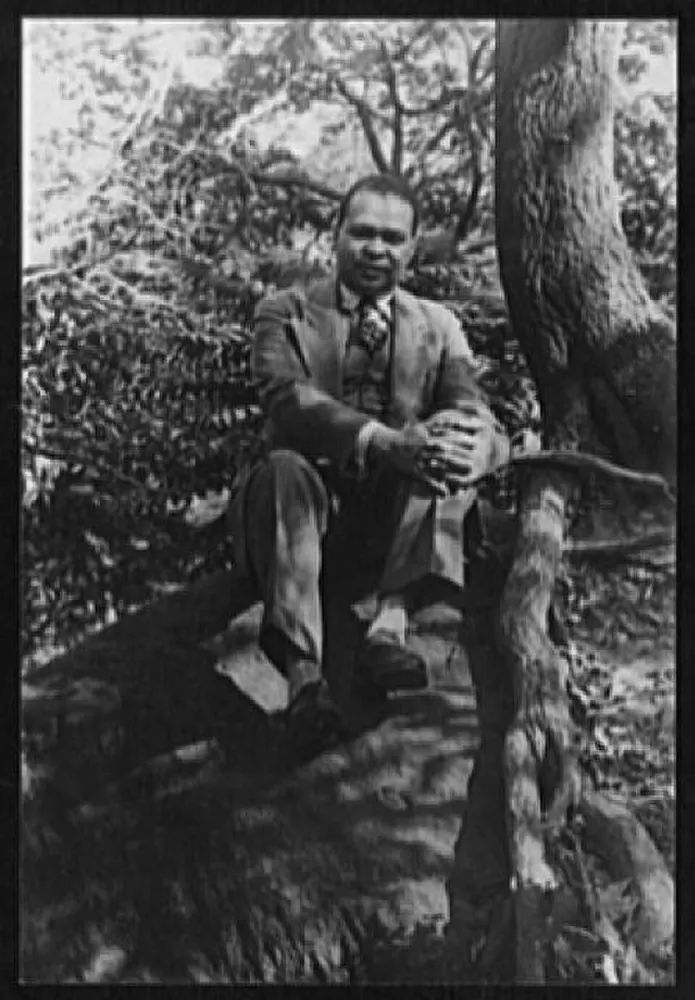
An uncertain start
Countee Cullen was one of the leading poets of the Harlem Renaissance. He was born in 1903, but where is not settled. Scholars have named New York City, Baltimore and Louisville, Kentucky. On his New York University transcript Cullen gave Louisville as his birthplace, while later in life he said he was born in New York. Little is known about his parents or his earliest years. As a teenager he was taken into the home of the Reverend Frederick Asbury Cullen, pastor of Salem Methodist Episcopal Church in Harlem, and his wife, and he took their name.
School and early fame
Cullen attended DeWitt Clinton High School in Manhattan, where he was already writing poetry. A school friend, Harold Jackman, stayed close to him for life, and Cullen dedicated his poem "Heritage" to him. He went on to New York University, where he was one of a small group of students elected to the honour society Phi Beta Kappa. He graduated in 1925.
Color and the Harlem Renaissance
The same year, 1925, Cullen published his first book of poems, Color. It was a critical success and made him one of the best-known young writers of the Harlem Renaissance. The University of Virginia Library's exhibit on the period presents the book as a landmark. Cullen often wrote in traditional forms, such as the sonnet and the ballad. Many of his poems take up race, faith and identity. "Heritage" asks what Africa means to a Black American who knows it only from a distance.
Cullen then studied at Harvard, earning a master's degree in English; sources give 1926 or 1927. In 1927 he published two more books, Copper Sun and The Ballad of the Brown Girl, and edited Caroling Dusk, an anthology of poetry by Black writers.
Marriage and Paris
In April 1928 Cullen married Yolande Du Bois, the daughter of W. E. B. Du Bois, in one of the most talked-about social events in Harlem. The marriage was unhappy and short; sources differ on exactly when it ended, but it was over within about two years. That same year Cullen won a Guggenheim Fellowship to study and write in France, and he spent time in Paris. In 1929 he published The Black Christ and Other Poems.
Teaching and later work
Cullen also wrote prose. His only novel, One Way to Heaven, a story of Harlem life, appeared in the early 1930s (sources give 1932 or 1934). In 1934 he began teaching French at Frederick Douglass Junior High School in Harlem, a job he held for the rest of his life. One of his pupils there was the young James Baldwin, who would become one of the most important American writers of the century.
Death and legacy
Cullen died in New York City on 9 January 1946. At the time he was working on the musical St. Louis Woman. Today he is read as one of the key voices of the Harlem Renaissance, alongside Langston Hughes and Claude McKay. The Academy of American Poets and university archives such as New York University's keep his work and papers available to readers.
Achievements
- 1925: Graduated from New York University, elected to Phi Beta Kappa, and published his first collection, Color
- 1927: Published Copper Sun and The Ballad of the Brown Girl and edited the anthology Caroling Dusk
- 1928: Won a Guggenheim Fellowship to work in France
- 1934 to 1946: Taught French at Frederick Douglass Junior High School in Harlem
Related entries
Sources
- Academy of American Poets, "Countee Cullen" (Reference)
- University of Virginia Library, "Color by Countee Cullen" (Harlem Renaissance exhibit) (Scholarly)
- New York University Archives, "New York University Archives Collection on Countee Cullen" (finding aid) (Primary source)
- Encyclopedia.com, "Countee Cullen" (Reference)
Share and cite
Cite this page
“Countee Cullen.” Kemet to Now, https://kemettonow.com/entry/countee-cullen.
Suggest a correction: opens once the database is connected.