Ronald McNair
1950 – 1986
Lake City, South Carolina; Houston, Texas
Ronald McNair was a laser physicist from Lake City, South Carolina, who earned his PhD at MIT (1976 by MIT's records, 1977 in NASA's biography) and became a NASA astronaut. In 1984 he flew on the space shuttle Challenger as the second African American in space, and he died with the rest of its crew when Challenger broke apart after launch on 28 January 1986.
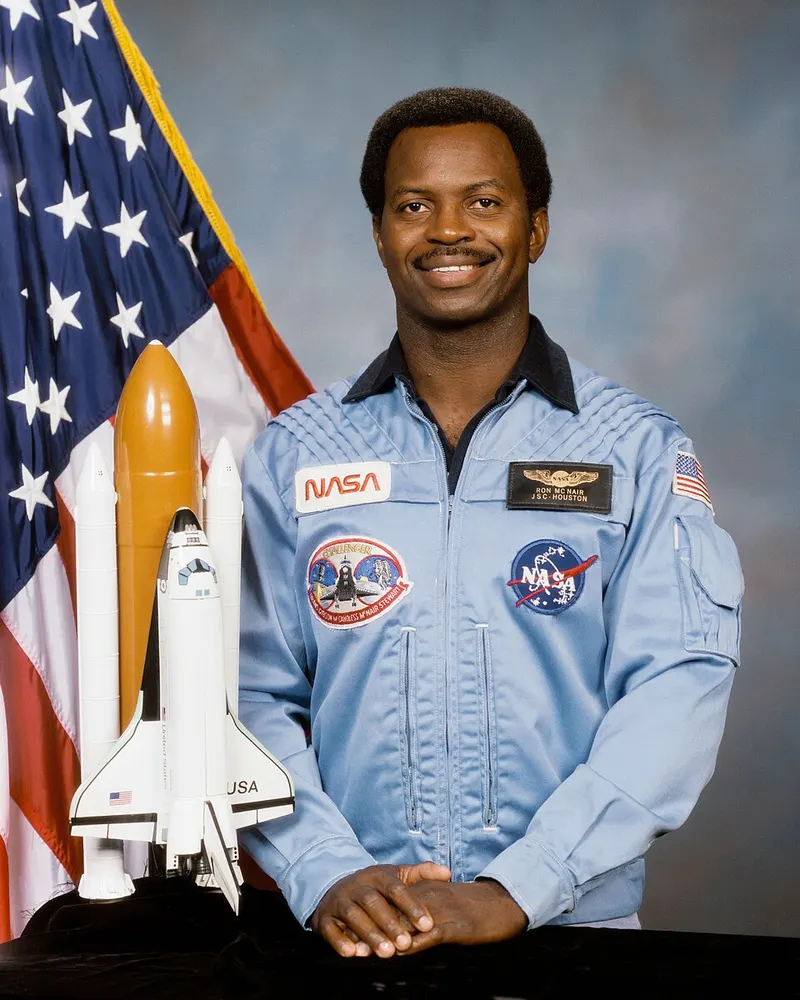
Growing up in Lake City
Ronald Erwin McNair was born on 21 October 1950 in Lake City, South Carolina, at a time when the town was segregated. His family had little money; his older brother Carl later remembered the family setting out pots and pans to catch rain from a leaking roof.
The library
As a boy, McNair loved science and reading. In the summer of 1959, when he was about nine, he went to the Lake City Public Library, which was for white people only, and tried to borrow books. When he was refused, he would not leave. Accounts differ on what followed: in some, the librarian threatened to call the police; in others, the police and his mother were called. In the end he was allowed to take the books. The story is told by his family and by many who honour him, with small differences in the details.
Education
McNair graduated as valedictorian of Carver High School in 1967. He studied physics at North Carolina A&T State University, graduating magna cum laude in 1971. He then went to the Massachusetts Institute of Technology, where he earned a PhD in physics with research on lasers. MIT's physics department lists his degree as 1976, while NASA's biography gives 1977. After MIT he worked as a laser physicist.
Astronaut
In 1978 NASA selected McNair as an astronaut candidate. He flew as a mission specialist on the space shuttle Challenger on mission STS-41-B, from 3 to 11 February 1984. He was the second African American to fly in space. A gifted saxophone player, he took his saxophone with him and played it in orbit; sources disagree about whether he was the very first person to play a saxophone in space.
Challenger
McNair was chosen for a second Challenger mission. On 28 January 1986, Challenger broke apart shortly after launch, and McNair died with the other six members of the crew. He was 35.
Legacy
Many places and programmes carry his name. The U.S. Department of Education's Ronald E. McNair Post-Baccalaureate Achievement Program, offered at universities across the country, helps students from low-income families, first-generation college students and students from underrepresented groups prepare for doctoral study. In Lake City, the library that once turned him away was later named for him. In 2011 a new library was built, and the old building became the Ronald E. McNair Life History Center, which tells his story.
McNair is remembered as a scientist who rose from a segregated small town to the frontier of space, and whose refusal to leave a library without his books has become a lesson for young people about determination.
Achievements
- 1971: Earned a degree in physics from North Carolina A&T State University
- 1976: Earned a PhD in physics from MIT, with work on lasers
- 1978: Selected by NASA as an astronaut candidate
- 1984: Flew as a mission specialist on STS-41-B
Related entries
Sources
- NASA, "Ronald E. McNair (Ph.D.), NASA Astronaut (deceased)" (biographical data) (Primary source)
- University of Rochester, Kearns Center, "Ronald E. McNair (PhD), NASA Astronaut" (Reference)
- Kent State University, "Life of Ronald E. McNair" (Reference)
- NASA, "Ronald E. McNair" (former astronaut page) (Primary source)
- NPR, "Astronaut's brother recalls a man who dreamed big" (28 January 2011) (Reference)
- Challenger Center, "Remembering the life and legacy of Ronald McNair" (2022) (Reference)
Share and cite
Cite this page
“Ronald McNair.” Kemet to Now, https://kemettonow.com/entry/ronald-mcnair.
Spotted an error or have a better source? Suggest a correction.