Robert Sobukwe
1924 – 1978
Soweto, Johannesburg, South Africa
Robert Sobukwe was a South African teacher and anti-apartheid leader who left the African National Congress with other Africanists and became the first president of the Pan Africanist Congress in 1959. After the PAC's anti-pass campaign of 1960 he was jailed until 1969; he died in Kimberley in 1978.
Early life and education
Robert Mangaliso Sobukwe was born in Graaff-Reinet, in the Eastern Cape of South Africa, on 5 December 1924. His family was poor, and with help from the local Methodist mission he went to Healdtown, a Methodist boarding school, where he was an outstanding student. He went on to the University College of Fort Hare, one of the few places where Black South Africans could study for a degree.
Fort Hare and the Youth League
At Fort Hare Sobukwe became involved in politics. In 1948 he joined the African National Congress Youth League, the movement's young and more militant wing. In 1949 he was elected president of the Students' Representative Council. He became known as a powerful speaker who argued that Africans had to lead their own liberation.
Teacher and lecturer
After university Sobukwe worked as a teacher. In 1954 he moved to Johannesburg to work at the University of the Witwatersrand (Wits), where he taught African languages; sources describe his post as lecturer in African Studies or as a teacher of isiZulu.
The Africanists and the PAC
Within the ANC, Sobukwe belonged to the group known as the Africanists. They objected to the ANC's alliance with white, Indian and Coloured organisations and to the Freedom Charter of 1955, which declared that South Africa belonged to all who lived in it. The Africanists argued that the land belonged to Africans and that Africans had to free themselves under their own leadership. From 1957 Sobukwe edited their journal, The Africanist.
In 1959 the Africanists broke away and founded the Pan Africanist Congress (PAC) at a meeting in Orlando, Soweto, and Sobukwe was elected its first president. Sources give March or 6 April 1959 for the founding.
21 March 1960
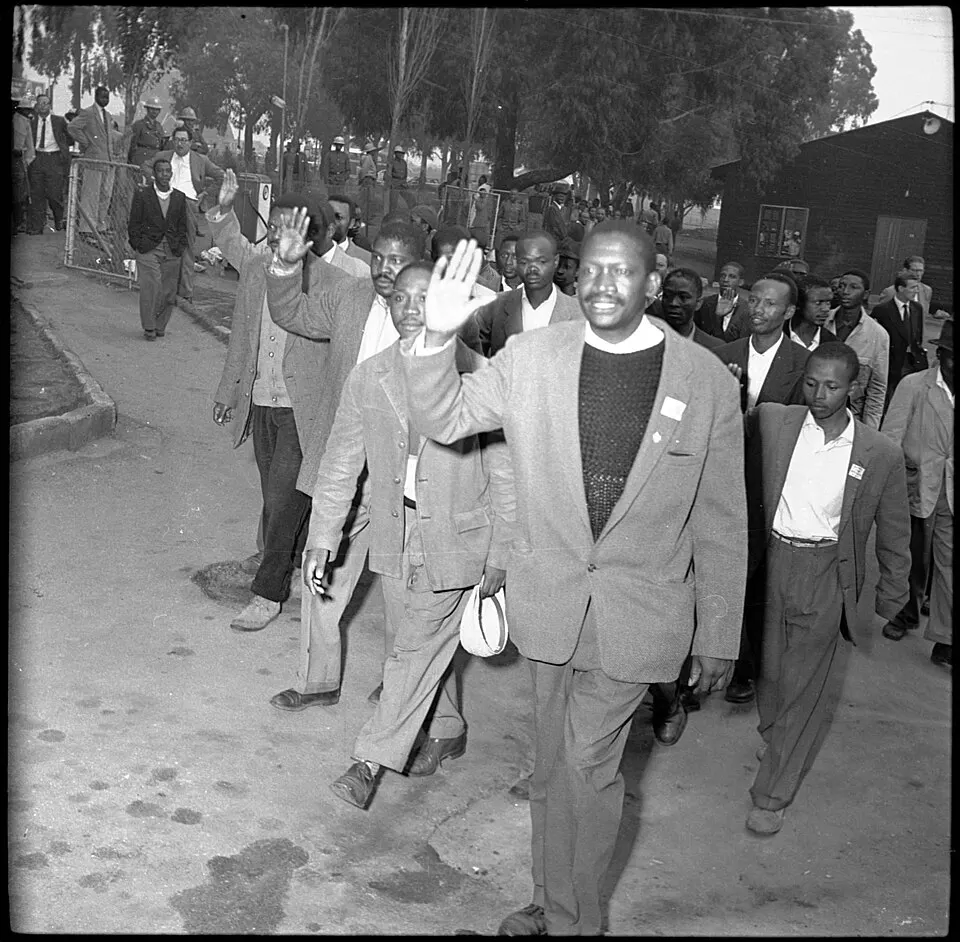
The PAC called for a national campaign against the pass laws, which forced Black South Africans to carry passes and controlled where they could live and work. On 21 March 1960 Sobukwe resigned his post at Wits and walked to Orlando police station without his pass, asking to be arrested. Across the country others did the same. At Sharpeville, police opened fire on a crowd of protesters, killing at least 69 people. The Sharpeville massacre shocked the world, and the government soon banned both the PAC and the ANC.
Robben Island and the Sobukwe clause
Sobukwe was convicted of incitement and sentenced to three years in prison. When his sentence ended in 1963, Parliament passed a new law that allowed the minister of justice to keep a political prisoner in detention year after year. It became known as the "Sobukwe clause," because for years he was the only person held under it. He was moved to Robben Island, where he was kept alone in a separate house, cut off from the other prisoners, until 1969.
Kimberley
On his release in 1969 Sobukwe was sent to Kimberley, in the Northern Cape, where he lived with his family under strict banning orders and house arrest. He was not allowed to take part in politics or to be quoted in the press. He studied law during these years, completed his articles in Kimberley, and opened his own law practice in 1975.
Death and legacy
Robert Sobukwe died in Kimberley on 27 February 1978, aged 53, of lung cancer. He was buried in Graaff-Reinet. His ideas of African self-reliance are widely seen as an influence on the Black Consciousness movement of Steve Biko and others. South African History Online and the University of South Africa remember him as one of the most principled leaders of the liberation struggle.
Achievements
- 1949: Elected president of the Students' Representative Council at Fort Hare
- 1957: Became editor of The Africanist
- 1959: Elected first president of the Pan Africanist Congress (sources give March or 6 April)
- 1960: Led the PAC anti-pass campaign of 21 March and was imprisoned
- 1963 to 1969: Held alone on Robben Island under the "Sobukwe clause"
- 1975: Opened a law practice in Kimberley
Related entries
Sources
- South African History Online, "Robert Sobukwe" (Reference)
- University of South Africa (Unisa) History and Memory Project, "Robert Sobukwe" (Scholarly)
- South African History Online, "Robert Mangaliso Sobukwe Timeline 1924 - 1978" (Reference)
- Africa Is a Country, "Lay him down on a high mountain" (2021) (Reference)
Share and cite
Cite this page
“Robert Sobukwe.” Kemet to Now, https://kemettonow.com/entry/robert-sobukwe.
Suggest a correction: opens once the database is connected.