Robert Smalls
1839 – 1915
Beaufort and Charleston, South Carolina
Robert Smalls was born enslaved in Beaufort, South Carolina, in 1839 and became a skilled pilot in Charleston harbour. In May 1862 he took the Confederate transport Planter out of Charleston with its Black crew and their families and handed it to the Union blockade. He went on to serve in the South Carolina legislature and the U.S. Congress, and spent his last years in Beaufort, in the house where he had been enslaved.
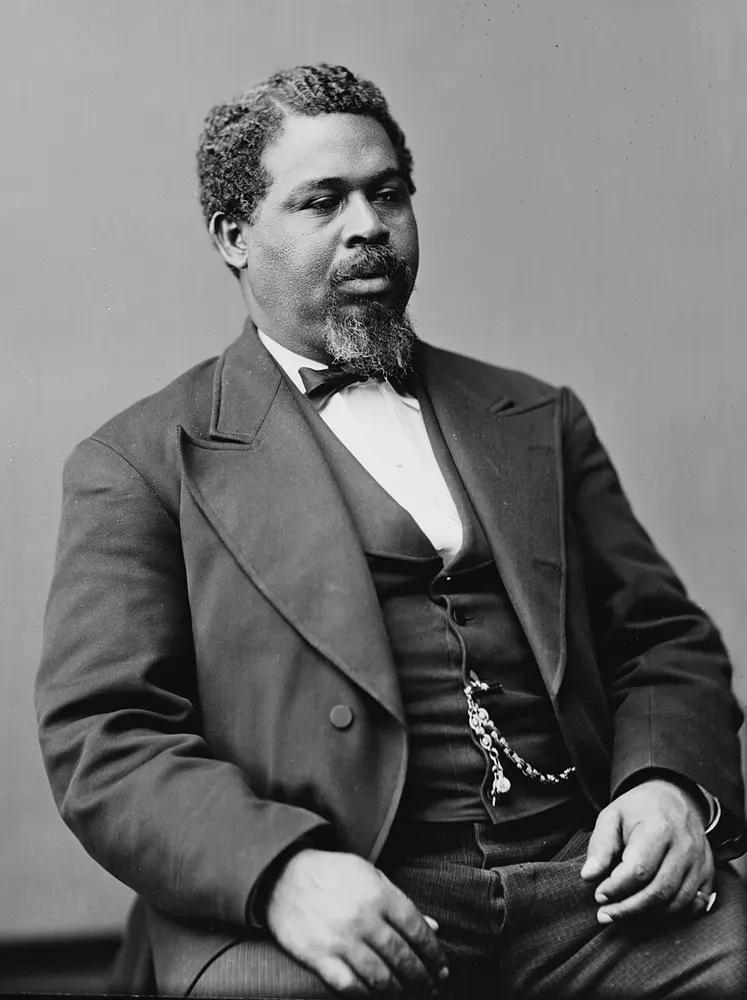
Enslaved in Beaufort
Robert Smalls was born into slavery in Beaufort, South Carolina, in April 1839. As a young man he worked in Charleston, where he became a skilled pilot of the harbour and its channels.
By 1862 he was working on the Planter, a steamer the Confederacy used as an armed transport in Charleston harbour.
Taking the Planter
On the night of 12 to 13 May 1862, while the ship's white officers were ashore, Smalls and the enslaved crew took the Planter out of its dock. They stopped to pick up their families and friends, because the crew would not leave them behind. Smalls steered past the Confederate forts in the harbour and, early on 13 May, handed the ship over to the Union warships blockading Charleston.
Sources give different counts of how many people were aboard, but all agree that the crew's wives and children escaped with them.
On 30 May 1862 Congress passed a bill awarding Smalls and his crew half the value of the ship and its cargo as prize money. The Hagley Museum's figures put that half at $4,584, of which Smalls received $1,500.
Smalls went on to serve with the Union navy for the rest of the war.
Reconstruction and Congress
After the war Smalls returned to Beaufort. In 1863, during the war, he had bought the house where he had been enslaved at a sale for unpaid taxes (one later account says he bought it from his former owner's family). He lived there for the rest of his life.
In 1868 he was a delegate to the convention that wrote South Carolina's new constitution, and that year he was elected to the state House of Representatives. He served in the state Senate from 1870 to 1874.
He was first elected to the U.S. House of Representatives in 1874 and took his seat in December 1875. He lost the election for one Congress but was elected again, and he served until 1887 (some sources say 1888). The Library of Congress describes him as a five-term congressman.
Later life
Under President Benjamin Harrison, Smalls was appointed collector of customs for the port of Beaufort (sources give 1889 or 1890). One account says he held the post until 1913.
Smalls died at his home in Beaufort in February 1915 (sources give the 22nd or 23rd) and was buried in the Tabernacle Baptist Church cemetery.
Achievements
- May 1862: Sailed the Confederate ship Planter out of Charleston to the Union fleet, freeing its crew and their families
- 1862: Congress awarded Smalls and his crew half the value of the ship and its cargo
- 1868: Delegate to the South Carolina constitutional convention; elected to the state House
- 1875 – 1887: Served in the U.S. House of Representatives, with a break; the Library of Congress describes him as a five-term congressman
- 1889 or 1890: Appointed collector of customs for the port of Beaufort
Related entries
Sources
- Library of Congress, Today in History, "April 5: Robert Smalls" (Primary source)
- National Park Service, Frederick Douglass NHS trading card, "The Planter" (Primary source)
- BlackPast, "Robert Smalls (1839-1915)" (Reference)
- House Divided Project, Dickinson College, "Smalls, Robert" (Scholarly)
- South Carolina Encyclopedia (University of South Carolina), "Smalls, Robert" (Scholarly)
- Hagley Museum and Library, "Freedom" (digital exhibit on the Planter) (Reference)
- American Battlefield Trust, "Robert Smalls and Planter" (Reference)
Share and cite
Cite this page
“Robert Smalls.” Kemet to Now, https://kemettonow.com/entry/robert-smalls.
Suggest a correction: opens once the database is connected.