Paul Laurence Dunbar
1872 – 1906
Dayton, Ohio
Born in Dayton, Ohio, to parents who had been enslaved, Paul Laurence Dunbar became one of the first African American poets to win national recognition. His first collection, Oak and Ivy, was self-published in Dayton in 1893, and he died there at 33.
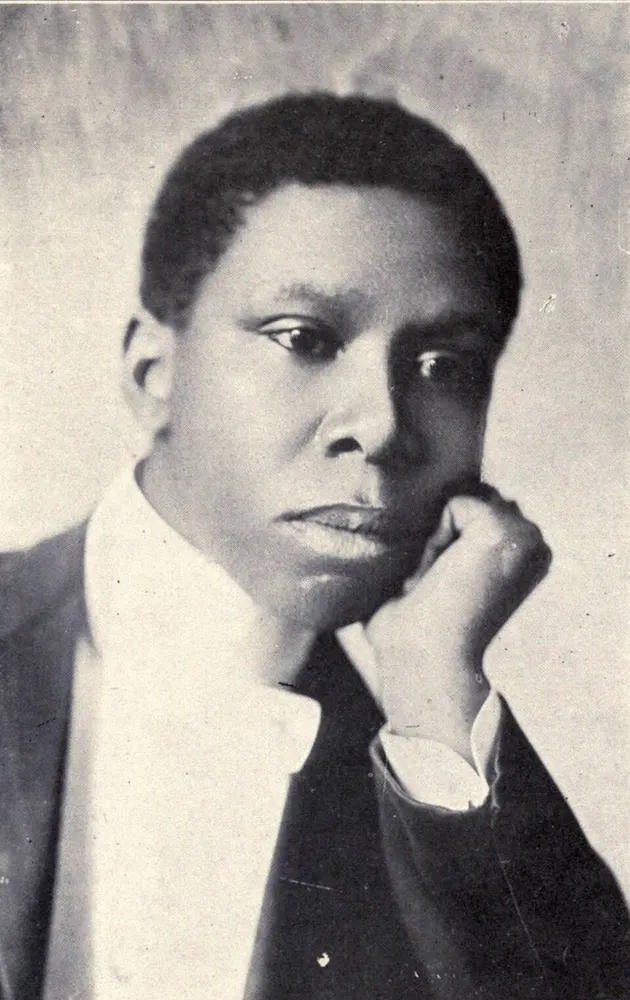
A poet from Dayton
Paul Laurence Dunbar was born in Dayton, Ohio, in 1872. His parents, Joshua and Matilda Dunbar, had both been enslaved in Kentucky before the Civil War. Joshua escaped slavery before the war ended; Matilda, once freed, settled in Dayton. The marriage did not last, and Paul was raised mainly by his mother.
While still a teenager he was publishing poems in the Dayton Herald. After finishing school in 1891 he took a job as an elevator operator, earning four dollars a week, and kept writing.
Oak and Ivy and Majors and Minors
In 1893 Dunbar paid to publish his first book of poems, Oak and Ivy, in Dayton, and he sold copies himself, often to passengers in his elevator, quickly earning back what the printing had cost.
His second book, Majors and Minors, followed (sources date it 1895 or 1896). The title described its two halves. The "majors" were poems in standard English. The "minors" were poems written in the dialect of Black Southerners, drawn from the speech he had heard from his parents and others.
National fame
In June 1896 the influential critic William Dean Howells reviewed Majors and Minors in Harper's Weekly. His praise made Dunbar famous across the country almost overnight.
Later that year Dunbar's poems from his first two books were gathered into Lyrics of Lowly Life, with an introduction by Howells. It became his best-known book.
Howells's praise had a cost. He singled out the dialect poems, and the attention they received came at the expense of Dunbar's poems in standard English, which drew far less notice.
Washington and later work
In October 1897 Dunbar took a job at the Library of Congress in Washington, D.C. Over the following years he wrote novels and short stories as well as poems.
Illness and death
Dunbar suffered from tuberculosis. As his health failed, he returned home to Dayton, where his mother cared for him in his last years. He died on 9 February 1906, aged 33, and was buried in Woodland Cemetery in Dayton.
The National Park Service tells his life story as part of Dayton Aviation Heritage National Historical Park. Dunbar is remembered as one of the first African American poets to win a national readership.
Achievements
- 1893: Self-published his first book, Oak and Ivy, in Dayton
- 1895 or 1896: Published Majors and Minors
- June 1896: Won national fame through William Dean Howells's review in Harper's Weekly
- 1896: Published Lyrics of Lowly Life, his best-known book
- 1897: Took a post at the Library of Congress
Related entries
Sources
- National Park Service, "Paul Laurence Dunbar's Life Story", Dayton Aviation Heritage National Historical Park (Primary source)
- Poets.org (Academy of American Poets), "Paul Laurence Dunbar" (Reference)
- Poetry Foundation, "Paul Laurence Dunbar" (Reference)
- Wright State University Libraries, CORE Scholar exhibit, "Paul Laurence Dunbar: Biography" (Scholarly)
- Smithsonian Libraries and Archives, "Paul Laurence Dunbar: Elevator Boy, Accomplished Poet" (2017) (Reference)
- Library of America, Story of the Week, "Paul Laurence Dunbar (1872–1906)" (Reference)
Share and cite
Cite this page
“Paul Laurence Dunbar.” Kemet to Now, https://kemettonow.com/entry/paul-laurence-dunbar.
Suggest a correction: opens once the database is connected.