The Neteru (Kemetic deities)
c. 3000 BCE – 6th c. CE; modern revival since the late 1980s
Ancient Egypt (Kemet); modern Kemetic communities worldwide
Netjer (plural netjeru) is the Egyptian word usually translated 'god'. It named the many divine beings of ancient Egyptian religion, who could take human and animal forms. Modern Kemetic communities have revived their worship since the late 1980s.
The word netjer
The ancient Egyptian word usually translated as "god" is netjer (plural netjeru, often written "neteru" today). In hieroglyphs it was written with the sign of a flag or pennant on a pole. Egyptologists disagree about why that sign stood for divinity: suggestions include the cult flags that stood at temple entrances, an object thought to hold sacred power, or a pole that once carried a particular god's emblem and later came to mean deity in general. In the Ptolemaic period, decrees written in both Greek and Egyptian rendered netjer as the Greek theos.
The term reached further than the great gods. The king became netjer through his coronation ritual, and certain specially marked sacred animals were ritually made vessels of a god's presence. The funerary ritual also made the dead netjer. One scholarly view, reported by Gale's World Eras, is that the word applied to any being that received ritual offerings.
Many gods, many forms
Egypt honored a very large number of deities. Gale's reference work counts about 2,000 worshipped across roughly three thousand years, and the Metropolitan Museum's 2025 exhibition Divine Egypt cited scholars' estimate of more than 1,500 at the civilization's height.
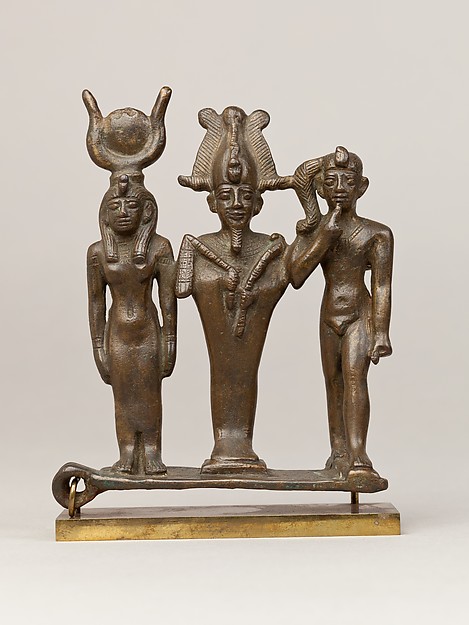
Gods appeared in human, animal and mixed forms. Horus, god of kingship and the sky, is often a falcon-headed man. Anubis, linked to mummification and funerary rites, has a jackal's head. Hathor can appear as a woman with cow's ears or as a cow. As the Met's curator Diana Craig Patch put it, "one form can be shared by many deities." Other major figures include Isis, goddess of protection and magic, and Osiris, god of the dead.
Divinity was maintained through ritual. Priests made daily offerings in temples and shrines throughout the country, and a Coffin Texts passage describes offerings as what "makes the gods divine."
End of temple worship
Temple cult lasted into the Roman and Byzantine eras. At the temple of Isis on Philae, a priest named Esmet-Akhom carved the last dated hieroglyphic inscription in 394 CE. According to Egypt's antiquities ministry, the temple stayed in use until Emperor Justinian I (r. 527–565) ordered pagan temples closed. It then became a church.
Modern revival
Ancient Egyptian religion is practiced again today, often under the name Kemeticism. In Profane Egyptologists (Routledge, 2018), the archaeologist Paul Harrison of University College London studies this movement through interviews with practitioners. He covers Kemetic Orthodoxy as well as independent and splinter groups, and asks how these communities' readings of the ancient sources challenge Egyptology's role as the gatekeeper of Egypt's past.
Kemetic Orthodoxy (the House of Netjer) was founded in the late 1980s by Rev. Tamara L. Siuda. It describes itself as an African Traditional Religion and as a polytheism with a "monolatrous" structure. In its teaching, Netjer is one divine force made up of many connected deities, the "Names of Netjer." Each full member is linked to a parent deity through a divination rite.
Achievements
- Some 1,500 to 2,000 deities worshipped over about three millennia of Egyptian history
- 394 CE: last dated hieroglyphic inscription carved at the temple of Isis, Philae
- 6th c. CE: Philae temple closed under the Byzantine emperor Justinian I
- Late 1980s: Kemetic Orthodoxy founded by Rev. Tamara L. Siuda
Related entries
Sources
- Encyclopedia.com (World Eras, Gale), "Terminology: Netjer" (Reference)
- Ella Feldman, Smithsonian Magazine, "Meet 25 of the Ancient Egyptians' Most Significant Gods and Goddesses" (on the Met's Divine Egypt exhibition, 2025) (Reference)
- Egyptian Ministry of Tourism and Antiquities, "Philae" (Primary source)
- Paul Harrison, Profane Egyptologists: The Modern Revival of Ancient Egyptian Religion (Routledge, 2018) (Scholarly)
- Kemetic Orthodoxy (House of Netjer), "What is Kemetic Orthodoxy?" (Primary source)
Suggest a correction: opens once the database is connected.