Mary Church Terrell
1863 – 1954
Washington, D.C.
Mary Church Terrell, born in Memphis, was a teacher, writer and civil rights activist who worked in Washington, D.C. for most of her adult life. She was the first president of the National Association of Colored Women and, in her eighties, challenged segregated restaurants in the capital.
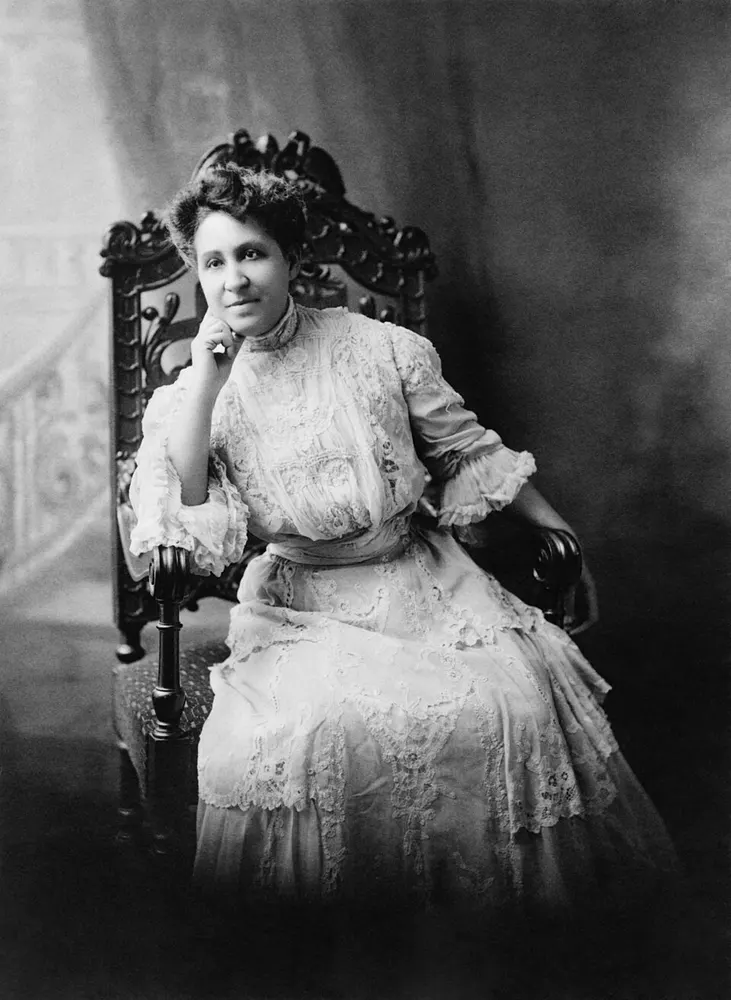
Memphis and Oberlin
Mary Eliza Church was born in Memphis, Tennessee, in 1863. She studied at Oberlin College in Ohio, one of the first colleges in the United States to admit both Black students and women. She graduated in 1884, one of only a few African American women in her class, and Oberlin awarded her a master's degree in 1888.
She became a teacher at the segregated M Street High School in Washington, D.C., where she met another teacher, Robert H. Terrell, a Harvard graduate who later became the city's first African American municipal judge. They married in 1891, and because the law barred married women from teaching, she had to give up her job. Washington remained her home for most of her adult life.
Leading Black women's clubs
In the 1890s Black women across the country were forming clubs to improve education, health and living conditions in their communities, and to answer the racist attacks made on Black women in the press. In 1896 several of these groups joined to form the National Association of Colored Women (NACW). The delegates chose Terrell as its first president, and she led the association until 1901.
Her personal motto, "Lifting as we climb", became the motto of the NACW.
Writer, speaker and suffragist
Terrell spoke and wrote widely against segregation and for women's right to vote, which she saw as a way for Black women to serve their communities and change conditions for their people. During Woodrow Wilson's presidency she joined members of the National Woman's Party in picketing the White House for suffrage.
She was also a charter member of the National Association for the Advancement of Colored People (NAACP), founded in 1909.
In 1940 she published her autobiography, A Colored Woman in a White World. Her papers, including drafts of the book, are held by the Library of Congress.
The Thompson's restaurant case
Terrell never stopped campaigning. In 1946 the Washington branch of the American Association of University Women turned down her application to join, and she fought the decision.
In 1950, when she was in her eighties, she and a small group went to Thompson's Restaurant in downtown Washington and asked to be served. They were refused because they were Black, and they promptly went to court. (Sources give January or February 1950 for the visit.)
The case, District of Columbia v. John R. Thompson Co., reached the U.S. Supreme Court. In 1953 the court ruled that restaurants in the District of Columbia could not refuse to serve people because of their race, which ended legal segregation in the capital's restaurants.
Mary Church Terrell died in 1954. She is remembered as one of the most important Black women leaders between Reconstruction and the modern civil rights movement.
Achievements
- 1884: Graduated from Oberlin College
- 1891: Married Robert H. Terrell, later Washington's first African American municipal judge
- 1896: Became first president of the National Association of Colored Women (served to 1901)
- 1909: Charter member of the NAACP
- 1940: Published her autobiography, A Colored Woman in a White World
- 1950: Refused service at Thompson's Restaurant in Washington and went to court
- 1953: The Supreme Court decided District of Columbia v. John R. Thompson Co. in favour of desegregation
Related entries
Sources
- U.S. National Archives, "African American Heritage: Mary Church Terrell" (Primary source)
- Virginia Commonwealth University Libraries, "Mary Church Terrell (1863-1954): Educator, Writer, Civil Rights Activist" (Scholarly)
- National Park Service, "Mary Church Terrell" (Reference)
- Oberlin College, "Learning from Activist Mary Church Terrell" (Reference)
- Library of Congress, "Mary Church Terrell Papers: About this collection" (Primary source)
- Smithsonian National Museum of African American History and Culture, "Because of Her Story: Activist and Suffragist Mary Church Terrell" (Reference)
- National Women's History Museum, "Mary Church Terrell" (Reference)
- Tennessee Encyclopedia, "Mary Eliza Church Terrell" (Reference)
Share and cite
Cite this page
“Mary Church Terrell.” Kemet to Now, https://kemettonow.com/entry/mary-church-terrell.
Suggest a correction: opens once the database is connected.