Elizabeth Keckley
c. 1818 – 1907
St. Louis, Missouri; Washington, D.C.
Born enslaved in Virginia, Elizabeth Keckley used her skill as a seamstress to buy freedom for herself and her son in 1855. She built a dressmaking business in Washington, became Mary Todd Lincoln's dressmaker, and published the memoir Behind the Scenes in 1868.
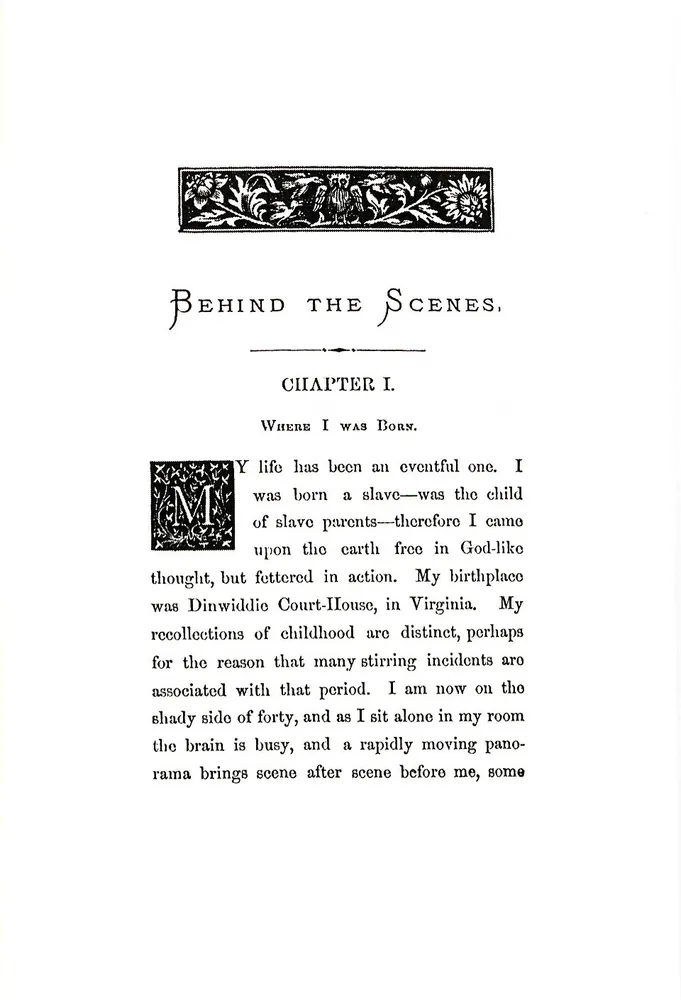
Born enslaved in Virginia
Elizabeth Hobbs, later Elizabeth Keckly, was born in February 1818 at Dinwiddie Court House, Virginia. Her mother, Agnes Hobbs, was enslaved in the household of Armistead Burwell, and Elizabeth was her only child. Most sources give 1818 as her birth year; one older reference gives about 1824. Her name also appears in two spellings: she signed it Keckly, while her book and many later writers used Keckley.
She grew up in slavery and learned to sew, the skill that would shape the rest of her life. Her son, George, was born around 1839 (one source says 1841).
Buying freedom in St. Louis
Around 1847 she was taken to St. Louis, Missouri, by the Garland family, who held her in slavery there. In about 1852 she married James Keckly, but only after Hugh Garland promised that she could buy freedom for herself and George for $1,200.
Raising that sum took years. In November 1855, with money borrowed from her sewing clients, she paid the $1,200 and became free along with her son. Sources give the date of her freedom papers as November 13 or November 15, 1855. She then worked to repay the loans.
A dressmaker in Washington
Keckly then moved to Washington, D.C. (the year is usually given as 1860), and set up her own dressmaking business. On March 4, 1861, the day of Abraham Lincoln's first inauguration, she met Mary Todd Lincoln, who hired her as her dressmaker. The National Park Service notes that over the next four years Keckly made many dresses for the First Lady; Encyclopedia Virginia records one commission of sixteen dresses.
The two women grew close. In August 1861 Keckly learned that her son, who had enlisted in the Union army as George Kirkland, had been killed at the Battle of Wilson's Creek in Missouri. Within about a year the Lincolns also lost a son, and the shared grief deepened the bond between the two mothers.
Helping people freed from slavery
During the Civil War, thousands of people escaping slavery arrived in Washington with little or nothing. In 1862 Keckly founded the Contraband Relief Association to help them. One account says she started it with about 40 members of Washington's Fifteenth Street Presbyterian Church. A few years later it took the name Ladies' Freedmen and Soldier's Relief Association.
Behind the Scenes
After Lincoln's assassination in 1865, Keckly stayed loyal to his widow. In 1867 she went with Mary Lincoln to New York City, where the former First Lady tried to sell her used clothing and jewelry to pay debts. The effort became a public embarrassment.
In 1868 Keckly published Behind the Scenes; or, Thirty Years a Slave, and Four Years in the White House. The book told the story of her life in slavery, her road to freedom and her years with the Lincolns. Keckly said she wrote it to answer what she saw as unfair attacks on Mary Lincoln and to help her. Instead it caused a scandal. Newspapers attacked it for revealing private details of her friendship with the First Lady, the Lincoln family took offense, and the two women never met again. Sources say Robert Lincoln worked to have the book taken out of circulation.
Later years
In the 1890s she headed the Department of Sewing and Domestic Science at Wilberforce University, a historically Black university in Ohio; a sewing kit she embroidered with the year 1895 survives from that time. She later returned to Washington, where she died in May 1907.
Today Behind the Scenes is read as an important narrative of slavery and as a rare inside account of the Lincoln White House written by a Black woman who earned her own freedom through her work.
Achievements
- 1855: Bought freedom for herself and her son in St. Louis
- 1860: Moved to Washington, D.C. and built a dressmaking business
- 1861: Became Mary Todd Lincoln's dressmaker
- 1868: Published Behind the Scenes
Related entries
Sources
- National Park Service, Ford's Theatre National Historic Site, "Elizabeth Keckly" (Reference)
- Encyclopedia Virginia (Virginia Humanities), "Elizabeth Hobbs Keckly (1818-1907)" (Scholarly)
- Elizabeth Keckley, Behind the Scenes (1868), excerpt, History Matters, George Mason University (Primary source)
- White House Historical Association, "From Slavery to the White House: The Extraordinary Life of Elizabeth Keckly" (Reference)
- Encyclopedia Virginia (Virginia Humanities), "The Remarkable Journey of Elizabeth Keckly" (timeline) (Scholarly)
Share and cite
Cite this page
“Elizabeth Keckley.” Kemet to Now, https://kemettonow.com/entry/elizabeth-keckley.
Suggest a correction: opens once the database is connected.