Egungun
At least the 15th century to present
Yorubaland (southwest Nigeria and Benin)
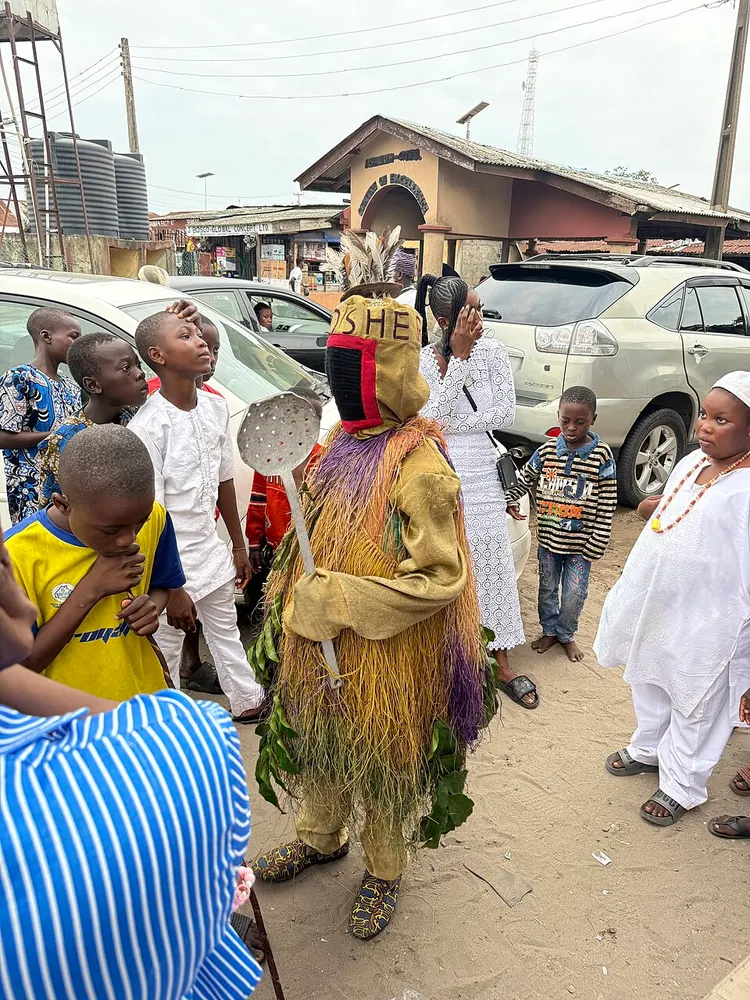
Egungun is a Yoruba masquerade tradition in which performers in layered cloth costumes embody the ancestors at public festivals. Museum scholarship dates egungun festivals in southwest Nigeria and Benin to at least the fifteenth century, though accounts of where and when it began differ. The tradition continues in Nigeria, the Republic of Benin and the Yoruba diaspora.
What Egungun is
Egungun (Egúngún) is a masquerade tradition of the Yoruba peoples of southwest Nigeria and the Republic of Benin. In Yoruba belief the dead remain part of the family. At Egungun festivals, masked and fully costumed performers come out into the streets and compounds to embody the ancestors, who are understood to return for a time to visit, bless and guide the living community.
The Art Institute of Chicago notes that an Egungun masquerade does not usually stand for one particular dead parent or grandparent. It embodies the spirit of the ancestors of a whole lineage. Because the performer is completely covered, no part of the human body shows; what the crowd sees is the ancestor, not the person inside.
Origins and debate
Sources agree that Egungun is old, but not on exactly where and when it began. The Brooklyn Museum describes it as centuries old, and museum scholarship dates Egungun festivals to at least the fifteenth century.
Different traditions explain its beginnings in different ways:
- Oral tradition places the first masquerades in Ile-Ife, the ancient Yoruba sacred city, at a time that cannot be dated.
- The Art Institute of Chicago links the festival in its familiar form to the Oyo kingdom, perhaps as early as the seventeenth century, and to figures in Oyo tradition including the queen mother.
- Other accounts credit Sango, a king of Oyo, with introducing the practice, and some scholars have suggested influence from neighbouring peoples such as the Nupe. That suggestion is debated.
Some verses of the Ifá corpus say that women originally controlled Egungun. These accounts are part of the tradition's own history, and they are given here as such, not as settled fact.
The cloth
Egungun costumes are among the most celebrated textile arts of West Africa. A costume is built up from many layers of cloth, often in panels that fly out as the masquerader spins. The Brooklyn Museum holds a costume made of more than three hundred pieces of textile from Africa, Europe and Asia, a sign of the wealth and trade connections of the family that made it.
The RISD Museum, which held the exhibition "Whirling Return of the Ancestors" in 2016 and 2017, explains that most Yoruba communities trace descent through the father's line, so the senior masquerades usually honour male ancestors. It also describes a simple, completely white masquerade made for honouring foremothers. A family may own several kinds of costume, depending on its means.
A costume's journey
In 2019 the Brooklyn Museum's exhibition "One: Egúngún" told the life story of a single twentieth-century costume. The museum traced it back to a family in Ogbomoso, Nigeria, from whom it had been stolen about seven decades earlier. The curator worked with the family, who had since made a successor costume, and they took part in a blessing of the project. The exhibition is an example of museums treating Egungun not only as art but as a living part of a family's religious life.
Today
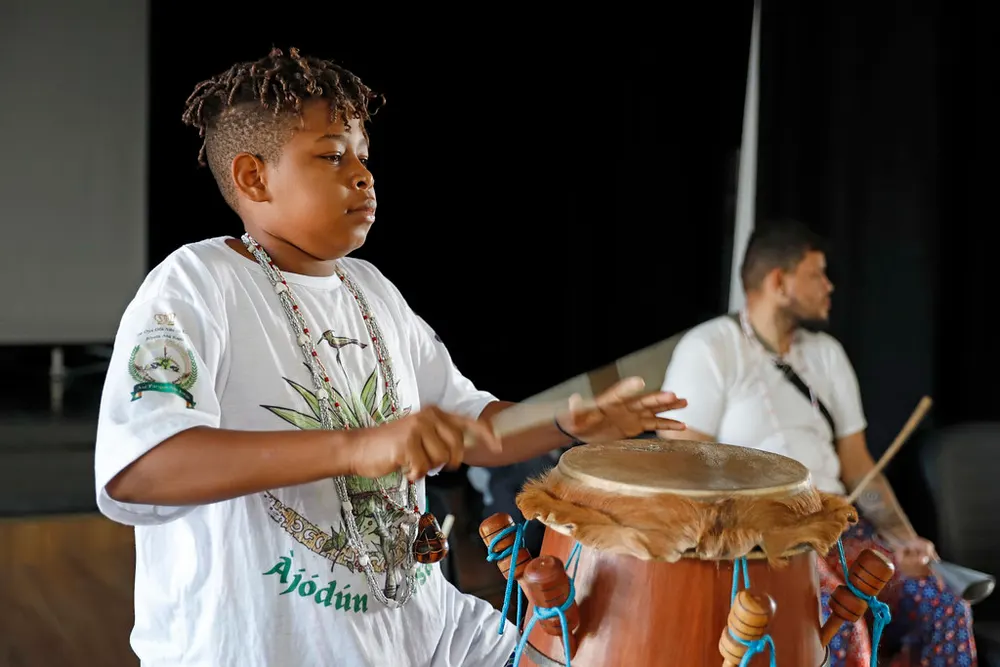
Egungun is still practised in Nigeria and Benin, where festivals bring masqueraders into the streets, and in the Yoruba diaspora. It sits within the wider world of Yoruba religion and Ifá, and its link with the ancestors connects it to related traditions such as Vodun in Benin and Togo and Candomblé in Brazil. This entry describes Egungun historically; its rites are kept by initiated members of lineages and societies and are not described here.
Related entries
Sources
- Brooklyn Museum, "One: Egúngún" (exhibition) (Reference)
- RISD Museum, "Whirling Return of the Ancestors" (exhibition) (Reference)
- Raclin Murphy Museum of Art, University of Notre Dame, Egungun collection record (Reference)
- Art Institute of Chicago, "Mask for Egungun (Ere Egungun)" (Reference)
- RISD Museum, "Egúngún: Mysteries Concealed in Magical Cloth" (Scholarly)
- Brooklyn Museum, "Egúngún Masquerade Dance Costume (paka egúngún)" (Reference)
Share and cite
Cite this page
“Egungun.” Kemet to Now, https://kemettonow.com/entry/egungun.
Suggest a correction: opens once the database is connected.