Audre Lorde
1934 – 1992
New York City
Audre Lorde was a Harlem-raised poet and essayist, the daughter of parents from Grenada and Barbados, whose writing on race, gender, sexuality and illness became foundational in Black studies, women's studies and queer theory. Her books include The Cancer Journals, Zami and the essay collection Sister Outsider. From 1984 she taught in Berlin and helped inspire the Afro-German movement. She was New York State poet laureate in 1991 to 1992 and died in 1992.
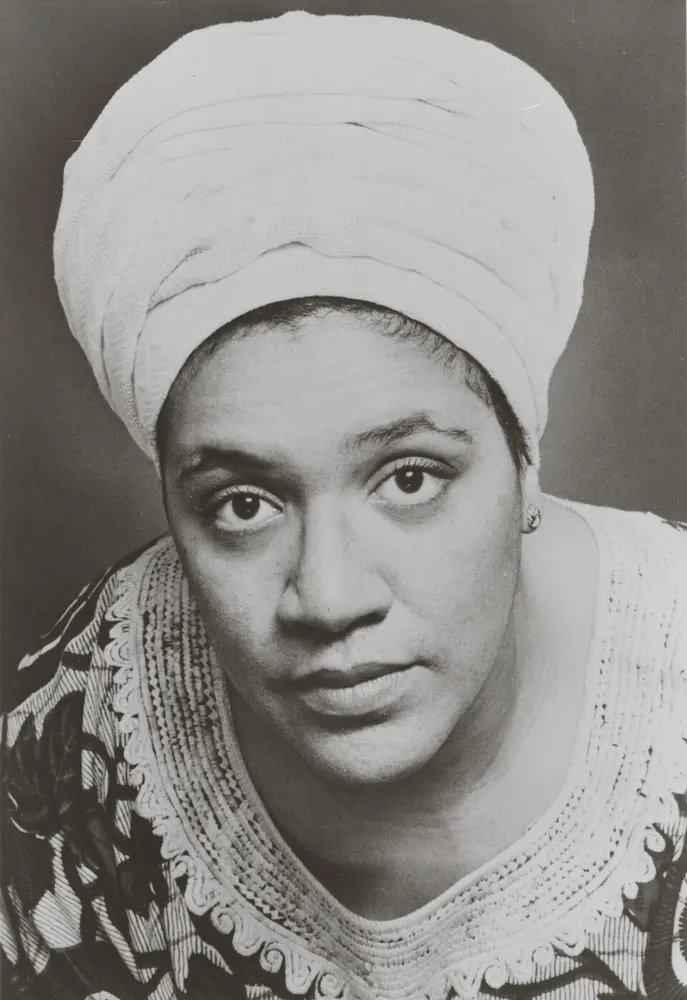
Harlem childhood and education
Audre Lorde was born in New York City in February 1934 and grew up in Harlem. Her mother came from Carriacou in Grenada and her father from Barbados.
She earned a bachelor's degree at Hunter College in 1959 and a master's degree in library science at Columbia University in 1961.
Poet
Her first book of poems, The First Cities, appeared in 1968. The book led to an invitation to Tougaloo College in Mississippi, where she became poet-in-residence. There she met Frances Clayton, who became her long-term partner.
Over the following decades she published many more collections of poetry, writing about race, gender and sexuality from her own life as a Black lesbian woman, mother and poet.
The Cancer Journals and Zami
After she was diagnosed with breast cancer and had a mastectomy, Lorde wrote The Cancer Journals (1980), an account of her illness and treatment. In 1982 she published Zami: A New Spelling of My Name, a book about her early life that she called a "biomythography", a mix of memoir, history and myth.
Sister Outsider and "The Master's Tools"
Her essays and speeches were collected in Sister Outsider (1984). One of the best known, "The Master's Tools Will Never Dismantle the Master's House", grew out of remarks she made in 1979 at a feminist conference marking thirty years since Simone de Beauvoir's The Second Sex. She criticised the conference for treating Black women and lesbians as tokens, and her words pushed women's studies programmes to widen their view.
These essays became foundational texts in Black studies, women's studies and queer theory.
Berlin and the Afro-German movement
From 1984 Lorde taught as a visiting professor at the Free University of Berlin, invited by the sociologist Dagmar Schultz. There she encouraged Black German women to write their own history. Sources credit her, together with Black German women, with the term "Afro-German", and she is linked to the founding of ADEFRA, a Black German women's organisation, and was a mentor to the poet May Ayim. Accounts differ on exactly how long she stayed in Berlin in each of the following years.
Final years
Lorde was named poet laureate of New York State for 1991 to 1992. She died of breast cancer on 17 November 1992 in St. Croix, in the U.S. Virgin Islands.
Achievements
- 1968: Published her first collection, The First Cities, and became poet-in-residence at Tougaloo College
- 1980: Published The Cancer Journals, her account of breast cancer and mastectomy
- 1982: Published Zami: A New Spelling of My Name, which she called a biomythography
- 1984: Published the essay collection Sister Outsider and began teaching at the Free University of Berlin
- 1991 – 1992: Poet laureate of New York State
Related entries
Sources
- Poetry Foundation, "Audre Lorde" (Reference)
- National Women's History Museum, "Audre Lorde" (Reference)
- BlackPast, "Audre Lorde (1934-1992)" (Reference)
- Academy of American Poets (Poets.org), "Audre Lorde" (Reference)
- Europeana, "How Audre Lorde made Black and feminist history in Germany and beyond" (Reference)
Share and cite
Cite this page
“Audre Lorde.” Kemet to Now, https://kemettonow.com/entry/audre-lorde.
Suggest a correction: opens once the database is connected.