Esoteric Studies: this section explores ideas outside mainstream scholarship. Each claim is labeled so you can judge it for yourself.
Esoteric Studies · The Anunnaki and Africa
The Dogon, the Nommo and Oannes
The claim
The Dogon of Mali hold ancient knowledge of the star Sirius, taught by water beings called the Nommo, who match the Babylonian fish-sage Oannes.
Dogon elders described a hidden, extremely heavy companion to Sirius that circles it about every 50 years, details astronomers confirmed only with telescopes. Their Great Masks record a ceremony cycle going back centuries. How they knew remains one of the most debated questions in anthropology.
What the Dogon described
In 1950 the French ethnographers Marcel Griaule and Germaine Dieterlen published what Dogon elders had taught them about Sirius, the brightest star in the night sky. The elders said Sirius has a companion, po tolo, that cannot be seen; that it is very heavy and made of a metal not found on Earth; and that it circles Sirius about every 50 years (Chandra X-ray Center).
Set beside what astronomers know, the match is striking:
- A hidden companion. Sirius does have one, Sirius B. It is far too faint to see with the naked eye and was first glimpsed through a telescope in 1862 (AMNH).
- Extremely heavy. Sirius B holds about as much mass as the Sun packed into a ball the size of Earth. It is roughly three million times denser than water (AMNH).
- A 50-year orbit. Sirius A and B circle each other about once every fifty years (AMNH).
Astronomers only understood how dense Sirius B was after about 1915, and the physics that explains it came in 1930 (AMNH). Griaule began his Dogon fieldwork in 1931.
The elders also spoke of a third star in the system. Astronomers have searched for one and not found it (Ortiz de Montellano).
Masks that span centuries
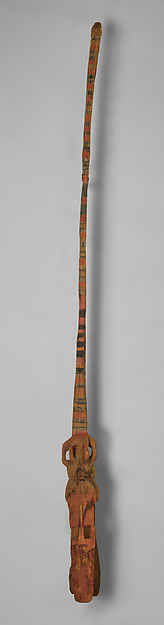
The Dogon live on and around the Bandiagara cliffs of central Mali, a UNESCO World Heritage landscape of 289 villages. Every sixty years the Awa mask society carves a new Great Mask (imina na) for the Sigui, a ceremony of world renewal that honors a whole generation of elders (The Met). The Sigui is timed by Sirius. Britannica, following Griaule's account, writes that it "rests on the belief that some 3,000 years ago amphibious beings from Sirius visited the Dogon". In the Dogon accounts Griaule recorded, these beings are the Nommo, ancestral teachers linked to water.
Because each Sigui leaves a new mask, the masks kept in rock shelters work like a calendar. Shelters holding three or four masks reach back to about 1720–1760, and one site with eight masks led Griaule to estimate that the ceremony was held as early as about 1300 CE (Ortiz de Montellano). The Met's own Great Mask is dated to the 18th–19th century. By the most cautious count, the Sigui itself is older than modern astronomy's discovery of Sirius B in 1862.
The Babylonian parallel
The Babylonian priest Berossus (3rd century BCE) wrote of Oannes, a being with a fish's body, a human head and human feet, who rose from the sea and taught people writing, building, law and farming (Dalley). Robert Temple, in The Sirius Mystery (1976), argued that the Nommo and Oannes were the same visitors from the Sirius system, remembered by two peoples. Berossus never mentions Sirius, so this link rests on Temple's reading (Sharp).
Where the skeptics' case is weak
Skeptics offer three main answers. Each leaves real gaps.
- "A Western visitor told them." Carl Sagan proposed that a European passed on modern astronomy in the 1920s, which then entered Dogon myth. None of the sources we checked names this visitor or shows when the visit happened. The window is also narrow: Sirius B's density was barely understood before Griaule arrived, and the idea had to reach a remote people and become sacred teaching within a few years.
- "Later researchers didn't find it." Walter van Beek and his team, working from 1979 to 1989, said the Dogon they spoke with gave Sirius little importance. But they spoke with different people, decades later. The anthropologist Mary Douglas replied that secret knowledge held by a few elders can fade within fifty years. Not finding a teaching later does not prove it was never there.
- "The masks were never carbon-dated." True, but no one has dated them any other way either. Counting the masks still shows a ceremony, timed today by Sirius, going back to at least the early 1700s.
There is also a pattern worth naming. For more than a century, Western scholars were quick to assume that African achievements must have come from outside, from the Bokoni stone walls to the founding of Egypt. A reader is entitled to ask whether the same reflex is at work here.
Where the skeptics have a point
Fairness runs both ways. Most of what we know comes through Griaule, who worked largely with one main informant, Ambara, through an interpreter, and who had studied astronomy himself (Ortiz de Montellano; Chandra X-ray Center). The third star has not been found. And the Dogon accounts do not mention other things a visitor from Sirius would surely have known (Chandra X-ray Center).
Our assessment: the Dogon tradition, the Sigui and its Great Masks are genuine and centuries old. The match between the elders' account of Sirius and modern astronomy is real and has never been fully explained. How the Dogon came to know it is still open, and this page leaves it open.
In the encyclopedia
Sources
- Walter E. A. van Beek, "Dogon Restudied: A Field Evaluation of the Work of Marcel Griaule", Current Anthropology 32(2), 1991 (via Yale eHRAF World Cultures) (Scholarly)
- Chandra X-ray Center (NASA / Smithsonian Astrophysical Observatory), "Sirius Matters: Alien Contact" (Scholarly)
- Stephanie Dalley, "Apkallu", Iconography of Deities and Demons in the Ancient Near East (University of Zurich, electronic pre-publication, 2011) (Scholarly)
- American Museum of Natural History, "Friedrich Bessel and the Companion of Sirius", Cosmic Horizons (Scholarly)
- Bernard R. Ortiz de Montellano, "The Dogon People Revisited", Skeptical Inquirer, November/December 1996 (Reference)
- Encyclopaedia Britannica, "Dogon" (Reference)
- Peter Sharp, "The Sirius Mystery" (review of Robert Temple), NZ Skeptics, 1999 (Reference)
- UNESCO World Heritage Centre, "Cliff of Bandiagara (Land of the Dogons)" (Primary source)
- The Metropolitan Museum of Art, "Imina Na (Great Mask)", Dogon peoples, 18th–19th century, 1977.394.33 (Primary source)