Hatshepsut
c. 1479 – 1458 BCE (reign; dates vary by chronology)
Egypt (Thebes)
18th Dynasty ruler of Egypt who acted as regent for the young Thutmose III, then took the full titles of a king and ruled for about two decades; her monuments include her temple at Deir el-Bahri.
A note on dates
Egyptian dates are reconstructed from king lists, astronomical records and radiocarbon dating, and the evidence can be read in more than one way, so published chronologies differ. The dates here, c. 1479–1458 BCE, are the ones used by the Metropolitan Museum and the Egyptian Museum in Cairo. The Met dates her kingship itself from about 1473 BCE.
Family and regency
Hatshepsut was a daughter of Thutmose I and his principal wife, Ahmose. She married her half-brother Thutmose II, and their daughter was Neferure. When Thutmose II died, his young son by a lesser wife, Thutmose III, came to the throne. Hatshepsut, his stepmother and aunt, governed for him as regent, a role Egyptian women had held before.
Becoming king
Sometime between the second and seventh years of Thutmose III's reign, Hatshepsut took the full titles of a pharaoh, with the throne name Maatkare. She ruled as senior co-ruler beside him for about two decades. Her inscriptions supported her claim with a story of divine birth from the god Amun and an oracle foretelling her kingship.
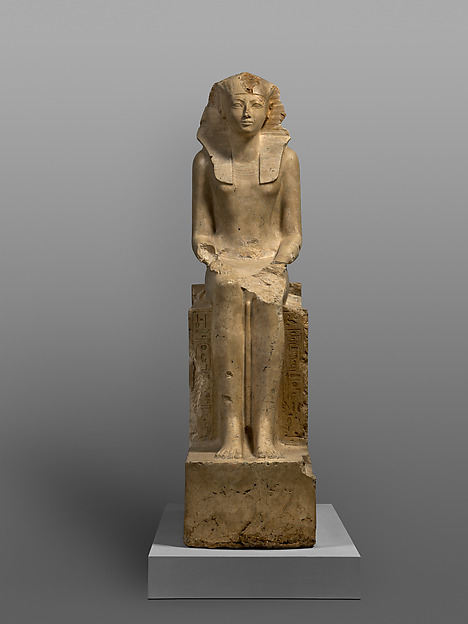
Her statues show the king's traditional regalia: the nemes headcloth, the kilt and, often, a false beard. Their inscriptions, though, often use feminine grammar, such as "Lady of the Two Lands" on the Met's seated statue. Curators at the Met read this mix as a deliberate way of presenting a woman in an office defined as male.
Building and trade
Her temple at Deir el-Bahri, set against the cliffs of western Thebes, held many statues of her, kneeling, standing, seated and as a sphinx. According to World History Encyclopedia, the courtier Senenmut oversaw her largest projects. She also raised obelisks at Karnak.
Reliefs at Deir el-Bahri record an expedition to Punt in her ninth regnal year. A fragment now in Cairo shows the ruler of Punt, Parehu, and his wife Ati, with men carrying incense, myrrh, gold and ivory. Where Punt lay is still debated. Scholars place it in the Horn of Africa or southeastern Sudan, and some in Arabia. The Polish Centre of Mediterranean Archaeology, which works at the temple, suggests the expedition revived Old and Middle Kingdom traditions.
After her reign
About twenty years after her death, Thutmose III had her images systematically destroyed. Faces, uraei and limbs were smashed while inscriptions were often left alone, and broken pieces ended up in a quarry near the temple, where the Met's excavators recovered many of them in the 1920s. Why this happened is unclear. Early twentieth-century scholars took it as proof that she had been a hated usurper. World History Encyclopedia gives the likeliest motive as restoring the traditional order, or ma'at, which a female king was thought to have broken, and notes that the erasure may have been less hostile than it looks. Her reign is judged more sympathetically today.
Achievements
- c. 1479 BCE: Becomes regent for the boy king Thutmose III
- Between Thutmose III's years 2 and 7 (c. 1473 BCE): Takes the titles of king, with the throne name Maatkare
- Builds her temple at Deir el-Bahri, Thebes, with courtier Senenmut in charge of major works
- Regnal year 9: Sends an expedition to Punt, recorded in reliefs at Deir el-Bahri
- Raises obelisks at Karnak
Related entries
Sources
- The Metropolitan Museum of Art (Aude Semat and Mona Eltahawy), "Spotlight: Challenging Power through Gender Representation" (Scholarly)
- The Metropolitan Museum of Art, "Seated Statue of Hatshepsut" (29.3.2) (Primary source)
- Egyptian Museum Cairo, "Wall reliefs with scenes of an expedition to Punt" (Primary source)
- Polish Centre of Mediterranean Archaeology, University of Warsaw, "The Punt Expedition in Hatshepsut's Temple" (Scholarly)
- Beth Harris and Steven Zucker, Smarthistory, "Hatshepsut" (Scholarly)
- Pınar Erdil et al., "Resolution of the High versus Low debate for Old and Middle Kingdom Egypt," PLOS One 20(5) (2025) (Scholarly)
- Joshua J. Mark, World History Encyclopedia, "Hatshepsut" (Reference)
Suggest a correction: opens once the database is connected.